05th Dec 2024
Christophe Baron is perhaps best known as Walla Walla, Washington’s OG Rhône Ranger. He launched his Cayuse label in 1997, and it has since become one of America’s most sought-after labels, specializing in Syrahs and Grenaches with jaw-dropping perfume and finesse. His iconoclastic Bionic Frog Syrah label is a cult classic, for want of a better term. But it wasn’t until recently that Christophe returned to his French roots. He was born and raised in Champagne, where his family has been growing grapes for generations, and studied viticulture in Marne Valley. When he and his sister inherited vineyards in the Marne region, he opted to take four of the oldest plots of Pinot Meunier, including vines planted in 1925. His first Champagne releases were from the 2014 vintage—all zero dosage and bottled in magnums, a style and format he continues. I recently caught up with him at his “studio” in Walla Walla to taste his current 2019 Champagne releases.

Bionic Redneck
“This is the wild west of the Marne Valley,” Christophe laughs as he opens the bottles. “We are the rednecks of Champagne. I left Champagne 30 years ago because of the snobbery, and nothing has changed.”
As Christophe suggests, it is only recently that Champagne buyers and collectors have started to take the Vallée de la Marne seriously, thanks to a handful of growers dedicated to highlighting the greatness of this area. When I began studying wine in the 1990s, we were taught that the Marne Valley was a lesser sub-region, largely suitable only as a blending component. Likewise, Pinot Meunier was Pinot Noir’s poor cousin, producing simple wines of less finesse. However, the grower Champagne movement over the last couple of decades has inspired a number of small “recoltant manipulants” to craft single vineyard/grape wines that defy these myths, including Benoit Dehu, Bérêche, Laherte Frères, and now Christophe Baron.
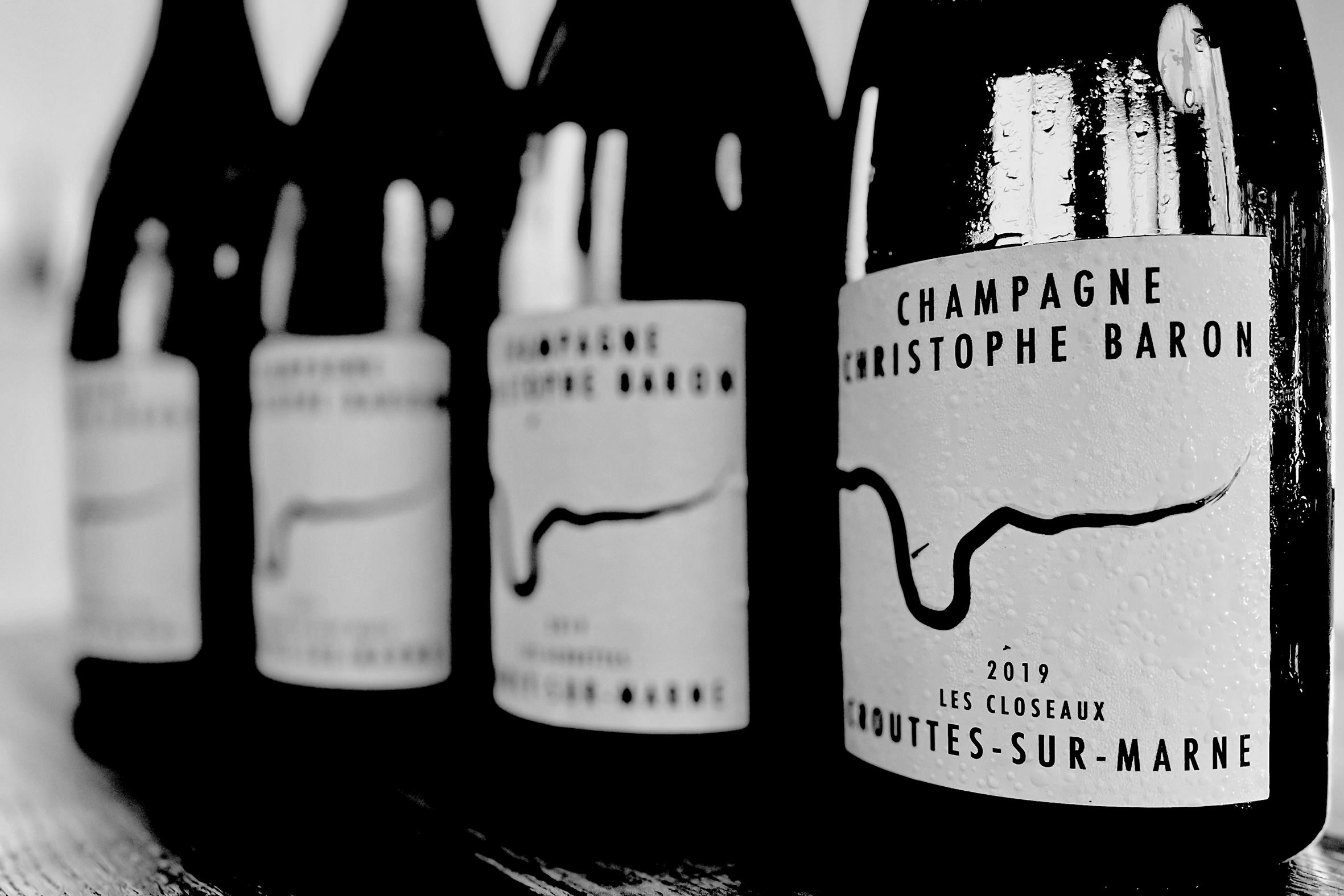
“We have very little topsoil in this area, maybe six inches,” Christophe points out. “Then it is pure calcaire de Saint-Ouen. This a limestone—the same that Paris is built on.”
Another important attribute is Christophe’s treasure trove of old vines.
“I own some of the oldest Pinot Meunier in Champagne,” says Christophe. “The oldest parcel, planted in 1925, goes into Les Closeaux. Les Closeaux is very close to the river and has more alluvial soils and sand with a tuffeau subsoil. This is just one and a half acres, located in the township of Crouttes-sur-Marne. The vineyard has a gentle slope and a south-west exposure. In 2021, we got an early attack of downy mildew here. I decided from 2022, I will make this vineyard as a rosé.”
The Le Dessus du Bois Marie vineyard was planted in 1966 and 1967 and is about 2 acres. Les Alouettes is a little under an acre, planted in 1968. And Les Hautes Blanches is the youngest vineyard, planted in 1969. Everything is 100% Pinot Meunier.
“Our yields are very, very small,” says Christophe. “Usually only 5000-6000 kilos per hectare—half what the CIVC allows. My cousins take care of the viticulture while I’m in Washington.”
As for the 2019 vintage, Christophe comments: "2019 was a warmer vintage, so it was tricky to make wines with finesse. But because I have lower yields, I can pick earlier to keep the freshness."
All the wines are fermented in French oak barrels, about 25% new. They undergo full malolactic followed by lees stirring. As mentioned before, all are bottled in magnums with no dosage, which works beautifully in a richer vintage like 2019. The use of a single grape from a single vineyard and a single vintage—without added sugar—absolutely highlights the differences between these four sites with perfect clarity. The labels pinpoint where each of the vineyards is located on the Marne River, but as a fan of the tongue-in-cheek Bionic Frog label, I’d like to see one of his Champagnes with a Bionic Redneck label in the future.
More feature articles about Christophe Baron’s projects, including Cayuse, are in the pipeline.
-
Article, Reviews and bottle shot by Lisa Perrotti-Brown
Photography by Johan Berglund

PRODUCERS IN THIS ARTICLE
> Show all wines sorted by scoreMore articles
Château Le Dôme 1997-2022
10th Sep 2026
9 tasting notes

Bordeaux 2024 Revisited
03rd Sep 2026
69 tasting notes
Château Jean Faure 2004-2023
10th Jul 2026
10 tasting notes
Bordeaux 2025 En Primeur
07th May 2026
382 tasting notes
Show all articles