19th Jun 2025
In Château Beauregard Chris Kissack finds a property on a certain upward trajectory.

Beauregard Reborn
Pierre-Élie Barry-Berthomieu sat slumped at the dining table, prisoner to an unfinished meal of pintade and potatoes. Pintade, guinea fowl to you and me, he was fine with. Potatoes, however, made him nervous. Their cultivation had long been forbidden in France, principally as they were believed to cause leprosy, but as a result of the tenacious efforts of Napoleon's agronomist Parmentier, who had spent much of his life promulgating the benefits of potato consumption, they had more recently gained in popularity. Suddenly, everywhere he went, Pierre-Élie was presented with potatoes.
And now in his own household too.
He pushed the plate away, and sighed. His woes lay heavy on his shoulders.
Pierre-Élie lived in tumultuous times, and despite having inherited a significant and historic vineyard in Pomerol from his father, Pierre-Henri Barry-Berthomieu, his position was anything but secure. Born during the reign of King Louis XVIII, who had been restored to the throne after years of rudderless post-Revolutionary government, he could remember his father telling him - when he had been just nine years old - of the uprising which had replaced Louis with Charles X. The July Monarchy, as it was known, had lasted just 18 years, before the 1848 Revolution kick-started the Second Republic.
"All this revolution," he cried out, his words echoing around the otherwise empty hall. "People don't have enough time to drink any more!"
Indeed, for Pierre-Élie, the situation was dire. His vineyard was failing, he was losing money hand over fist, and he had taken to a rather radical solution. A few years ago he had begun planting common madder, which at the time had been in demand for its roots, which are as thick as your index finger, and bleed the same colour when cut. The plant grew well on the estate's more sandy and gravelly soils, and the harvest sold for a good sum. The roots were processed to produce the rich red dye known as rose madder, popular with France's textile trade.
"They probably used it to dye the tricolour," he muttered to himself.
The French tricolour had been reintroduced as France's flag in 1830, replacing the plain white flag of the Bourbon king.
The problem was, even with all these efforts, Pierre-Élie was still facing bankruptcy. He had since given over a much larger part of the vineyard to the madder plant, Rubia tinctorum, pulling up some of his vines in the process. Other parts he no longer tended, the vines now growing wild, as Pierre-Élie poured all his time and money into his rose madder basket.
But now, thanks to the Mexicans, all this looked set to end.
Yes, the Mexicans. Pierre-Élie had never imagined that the Mexican War of Independence, a struggle for freedom from the Spanish Empire, would have had such a profound influence on his fortunes, but it did. Following their victory the Mexican monopoly on carmine, the rich red dye extracted from the cochineal insect, came to an end. Cultivation of the cochineal had spread, first to Guatemala, then the Canary Islands and North Africa. And now even next-door, in Spain. Carmine was now widely available, and becoming more and more affordable. As a consequence orders for his madder root had, in the past few years, tumbled off a cliff.
It was the end for Pierre-Élie. He was ruined.
He drew his plate back towards him, and began to fork the first of the potatoes into his mouth.
It was just a few years later, in 1854, that Château Beauregard, an estate which had been passed down through three generations of the Barry-Berthomieu family, was sold. The buyer faced a gargantuan task, with vineyards and winemaking facilities both in need of urgent attention.
It was the end of the decline, and the beginning of recovery. Another cycle in the history of this Bordeaux property began.

The Cycle of Decline and Recovery
Look at the history of almost any large Bordeaux estate and it will tell a tale, over several centuries, of waning decline and waxing recovery. Few estates, if indeed any, plot a course of continued and unwavering improvement. Famous first growths and super seconds have all, at one time or another, spent some time in the doldrums.
In many cases the causes are similar or indeed the same; the new vine diseases of the 19th century culminating in phylloxera and the need to replant, and then the economic malaise of the 20th century, not to mention two World Wars, all have played their part. To the best of my knowledge though, it is only Château Beauregard which saw the vineyards uprooted and replanted with the perennial crop plant Rubia tinctorum. It is a quite unique story within Bordeaux.
Following the sale by Pierre-Élie Barry-Berthomieu to a Monsieur Durand-Desgranges there was some recovery, most notably in the vineyard, which was expanded and replanted. The madder plant was, presumably, uprooted. The property then passed through several pairs of hands, before coming to the Clauzel family, who in 1991 sold it to Foncier-Vignobles, the vineyard-owning arm of the bank Crédit Foncier de France. The new owners drafted in Vincent Priou to manage the estate.
It was during Vincent's era that I first visited the estate, and began to regularly taste the wines. They were perhaps best described as solid; recognisably Pomerol, but never hitting the heights that neighbouring estates, just a stone's throw away on the plateau of this most famous appellation, would regularly achieve. The property was ripe for investment and reinvigoration, something which was perhaps lacking when held as an asset by the bank.
It was time for the cycle to turn once more. This time the new owners, the Moulin-Houzé family, would bring an unparalleled level of investment accompanied by a new sense of energy and drive.
The Moulin-Houzé Family
Those who follow the world of French business and retail will be familiar with the name Moulin-Houzé, but I suspect for many who shop beyond France's borders this name will be unknown. Allow me to enlighten you.
The Moulin-Houzé family are the modern representatives of a French business dynasty, one which can trace its origins back to Théophile Bader (1864 - 1942), cofounder of Galeries Lafayette, arguably France's leading department store. His daughter married Max Heilbronn (1902 - 1998), who founded the French supermarket Monoprix, the Angers branch of which has been the source of many a baguette when I am staying in town for the annual Salon des Vins de Loire. A committed member of the French Resistance during World War II, Heilbronn was captured and held at Buchenwald, where he met Étienne Moulin, who would subsequently marry Heilbronn's daughter.
Etienne Moulin's own daughter Christiane married Philippe Houzé in 1971, and today the Moulin-Houzé clan maintain their ownership of Galeries Lafayette and Monoprix, and they also own 12% of Carrefour SA, a French supermarket chain which in terms of revenue is - at the time of writing - the world's seventh-largest retailer. This puts them at the head of one of Europe's most significant retail organisations.
The Moulin-Houzé family therefore have the financial clout to invest and improve upon anything they might purchase, including a sizeable Bordeaux property (or maybe two - more on that later). And, as personal friends of Florence and Daniel Cathiard, who took on a rather directionless Château Smith-Haut-Lafitte and turned it from a state of woeful under-performance into one of the region's leading properties, they have contacts with the necessary savoir-faire on hand. In fact the Cathiards took a minority share in the Beauregard purchase, and so it is also in their interests to see the Moulin-Houzé project succeed.

We Will Do It In Ten Years
"We will do at Beauregard what we have done at Smith-Haut-Lafitte," said the Cathiards (presumably in unison) at the time of the Moulin-Houzé acquisition, referring to their revitalisation of that estate, "but we will do it in ten years."
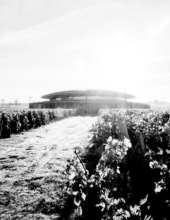
It is a statement that is clearly etched on the mind of Augustin Belloy, the husband of Laurène Houzé (one of three offspring born to Christiane and Philippe Houzé), and representative of the family at the estate. This drive to revivify Château Beauregard in a shorter time frame than has been achieved at Château Smith-Haut-Lafitte was evident from the outset, with the early creation of a new vat cellar adjacent to the estate's barrel cellar. Having only purchased the estate in July 2014, this new cellar was up and running in time for the 2015 harvest. A cold room, to control the temperature of the freshly picked bunches, was installed and inaugurated in the 2017 vintage. Alongside, the château was completely refurbished, and the facade was opened up to the passing world with the removal of a giant hedge which had for so long screened the property from view. This last point is perhaps a minor one in Beauregard's renaissance, but symbolically it was important; a property that was previously easily overlooked now simply cannot be missed.
Meanwhile, in the vineyard, general manager Vincent Priou has overseen a conversion of methods to certified organic viticulture. This applies to the entire 17.5 hectares of the estate's vineyard, the majority of vines lying in a single block around the château, although there are also a few detached parcels just south of Catusseau, and a single parcel in Libourne. The majority is planted to Merlot, with a few parcels of Cabernet Franc, and a single parcel of Cabernet Sauvignon situated east of the château, close to the road.
Come harvest time the fruit is picked by hand, as you would expect, and it then arrives at the reception area, to be sorted over one of two sorting lines. This includes a traditional sorting by hand-and-eye, high-frequency destemming of the berries, and then sorting again using optical technology. The berries are then deposited in small 3-hectolitre cuvons which can be wheeled around the cellar; these are elevated to the top of the vats via a lift, so their contents may be deposited in the vats using only gravity.
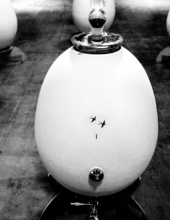
These 22 new tronco-conical vats are made of concrete, giving them excellent thermal inertia, and each incorporates a dedicated cooling system to ensure the fermentation temperature is controlled to between 25°C and 30°C. Once complete there is a period of maceration which varies according to vat and vintage but which is typically between three and six weeks, after which the new wine is run into barrel. Here it goes through malolactic fermentation, and the wine rests for between 15 and 20 months before blending and bottling. The use of new oak varies a little, but is modest, generally between 45% and 60%.

The Wines
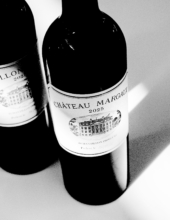
I stopped off at Château Beauregard in April 2025 and sat down to dinner with Augustin Belloy and eight vintages of the estate's wine. The focus was clearly the work done and what has been achieved since the Moulin-Houzé acquisition, so these eight wines were all youngsters from the modern era. This was not the time to showcase older vintages from the preceding era when, being frank, the wines of Beauregard were not infrequently rather lacklustre.
The eight wines were poured in pairs, in a manner which facilitated their comparison, and I thought it might be interesting for readers to know how the eight vintages were carved up. We started with the two weaker vintages, 2017 and 2021, followed by two high-quality but classically styled vintages which bear some resemblance to one another, 2016 and 2019. Then came two rather more solar vintages, the richly styled 2015 and 2018, before we finished with two recently crafted jewels in the shape of 2020 and 2022. In this run-down of the wines, however, I will come to them in chronological order.
Starting with 2015, this was poured from double magnum, while all the more recent vintages were from magnum, an immediate distinction. This was the first vintage made exclusively under the direction of the new owners, the purchase having come midway through the 2014 season, and it is also the first to have been vinified in the new facilities. It shows well, with a ripe and solar character. Nevertheless it was outclassed by the 2016 vintage, which shows the same perfumed aromatics and charm I have found in a number of other 2016s tasted over the past couple of years,
The 2017 vintage was a frosted one, and the difficulties presented by the season show through in the wine; not even the inauguration of a new cold room (which seems to be the new must-have 'gadget' in Bordeaux in recent years) could ameliorate the hit the harvest took. The 2018 vintage is certainly a better proposition, although showing some solar maturity with more than a touch of exoticism. My choice from these 'middle years' would be the 2019 vintage, which saw the introduction of amphorae alongside the barrels for the élevage. This wine displays a more focused, polished and tense style, and offers a little more precision than the 2016 vintage.
The 2020 vintage should not be ignored though, and is a good result in a favourable vintage. My feeling was that it fell in just behind 2019, with a slightly richer but less linear style, but I would not be surprised if it had a broader appeal than that vintage. The weak link in this chain of more recent years was 2021, which seems to have presented Vincent Priou and his team greater challenges than did 2017. This, like many wines of the 2021 vintage, is already suitable for drinking now, and will be best dispatched in its youth.
If you do have a hankering to add some Beauregard to the cellar, there is one clear winner, and that is the 2022 vintage. With excellent conditions, the use of some Cabernet Sauvignon in the blend, and an élevage which saw the amphorae used in 2019, 2020 and 2021 replaced by larger 500-litre barrels, this is the best example of Beauregard here, and one of the better wines I have tasted from this estate in recent years.
Conclusion
There is no doubt based on what I have seen and tasted that Château Beauregard is a property on the up. Having said that, regardless of the team's ten-year plan, I have never yet encountered a Bordeaux property which has achieved change through revolution rather than evolution. Like a super-tanker changing course, turning around a 17.5-hectare estate takes time, with new investment in vineyards requiring years to be translated through into the wine. The construction of new cellars can have a more immediate impact, but even here I sense there is ongoing change and experimentation, with cold rooms, amphorae and larger oak barrels all playing their part as the Beauregard team feel their way.
Don't take these words as being negative. I enjoyed these wines. I felt these eight vintages were (mostly) tasting much better than expected, better than the boring Beauregard of old. I would be delighted to encounter the 2016, 2019, 2020 or 2022 vintages again. It is just that I think there is still more to come here; it would be rewarding to see that 2022 vintage eclipsed by some future as yet intangible vintage. I doubt 2023 or 2024 will be up to the task, but I wouldn't bet against 2025. Not yet, anyway.
The transition from faceless bank to the Moulin-Houzé family has clearly been of great benefit to Château Beauregard. I predict a fine future here, as well as at the Moulin-Houzé's other more recent purchase Château Petit Village, which is situated on the opposite side of the road. These are now both names worth watching in Pomerol.
What I don't predict is a return to planting of the madder plant at Château Beauregard.
We all know how that one worked out.

PRODUCERS IN THIS ARTICLE
> Show all wines sorted by scoreMore articles
Château Le Dôme 1997-2022
10th Sep 2026
9 tasting notes

Bordeaux 2024 Revisited
03rd Sep 2026
69 tasting notes
Château Jean Faure 2004-2023
10th Jul 2026
10 tasting notes
Bordeaux 2025 En Primeur
07th May 2026
382 tasting notes
Show all articles