30th Oct 2026
Most great Bordeaux estates change hands for money. Clos Fourtet changed hands for a slice of Château Margaux.
When we talk about Clos Fourtet today, we talk about the Cuvelier family, biodynamics and a string of brilliant modern vintages. Before them, for half a century, it was the Lurtons. But the story of the two vintages in my glass begins with a third family - one that rarely appears on the estate's timeline beyond a single line.
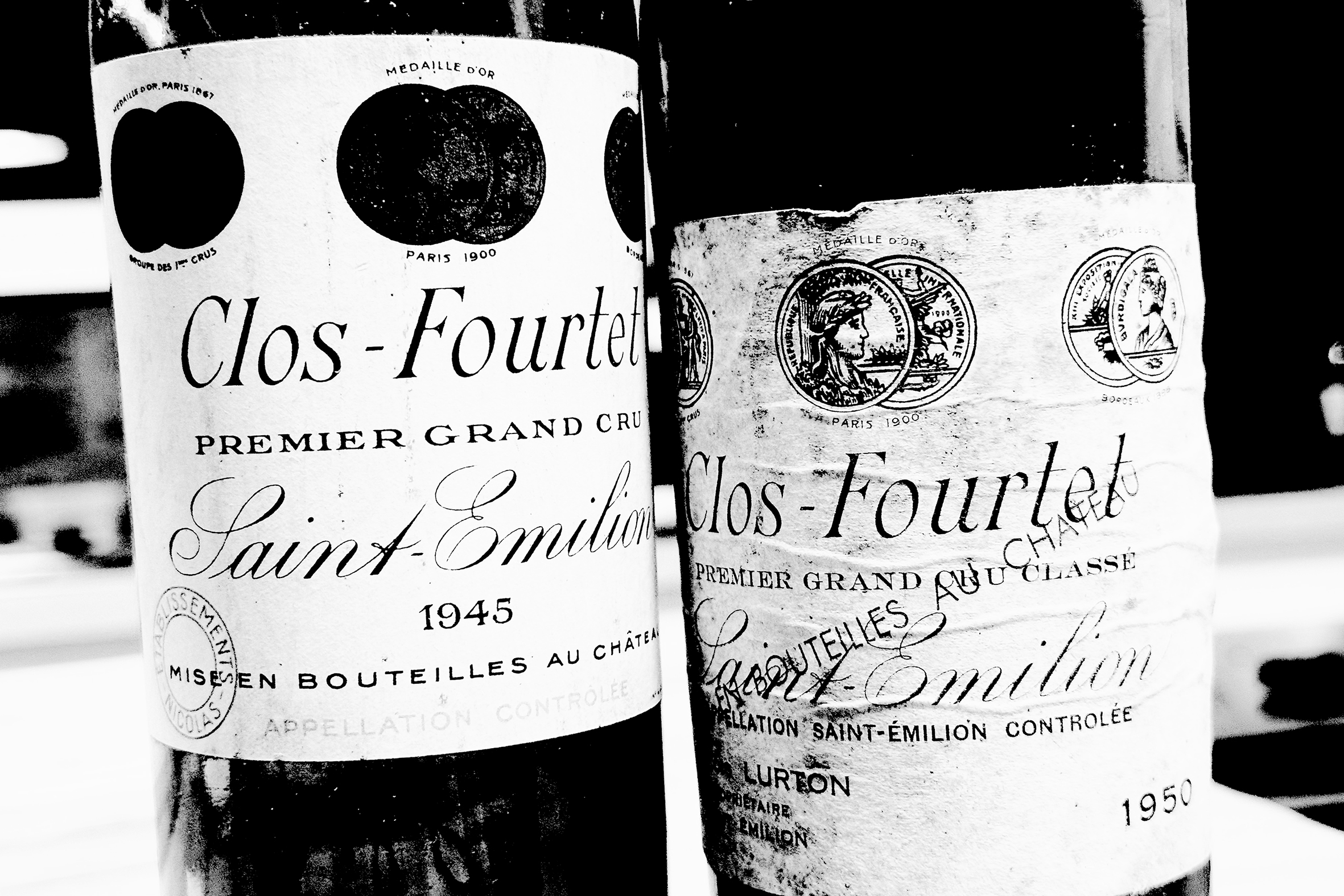
1945 and 1950. Five years apart, two owners apart. One is the legendary post-war vintage of the Ginestet era; the other belongs to a new chapter that opened with one of the most unusual deals the Place de Bordeaux has ever seen.
Trading Places
The Merchant on the Hill
Long before it was a vineyard, Clos Fourtet was a fort. "Camp Fourtet" guarded the entrance to medieval Saint-Émilion from the limestone plateau, right at the town's gates. The Rulleau family turned it into a wine estate, and in the late 1860s the old military name gave way to "Clos Fourtet."
The modern era began in 1919, when the estate was bought by Fernand Ginestet.
Ginestet was not a vigneron. He was a négociant - and one of the most powerful on the Place de Bordeaux.
He had founded his trading house in 1897 on the quai de Bacalan. He went on to preside over the Syndicat des Négociants en Vins et Spiritueux de Bordeaux and played a key role in what would become the Bordeaux interprofession. His model was simple and, for its time, ambitious: unite the trade with the ownership of great properties.
Clos Fourtet was one piece of that portfolio. Margaux was to become another. From 1918, the estate's labels carried three gold medals - a design that survives to this day.
1945: Born in Frost
The war in Europe ended in early May 1945. Bordeaux barely had time to celebrate.
On May 1 and 2, a brutal cold snap swept the region. In places it snowed; the frost destroyed young shoots across the vineyards. Together with localised hail, it cost Bordeaux around 60% of its potential crop.
What survived was then tested by heat. June was warm and showery, and July brought a heatwave with peaks of 36 °C. A slightly cooler August with a few showers carried the remaining bunches to full ripeness. Picking began in mid-September under near-drought conditions.
Few grapes, tiny berries, enormous concentration - the recipe for a legend.
The Clos Fourtet of 1945 was also a different wine from the one we know today. According to David Peppercorn, Cabernet Sauvignon and Cabernet Franc each occupied roughly a quarter of the vineyard at the time. Today Merlot makes up around 85%.
Then there is the question of the bottle itself. In the 1940s, château bottling was far from universal: much of Bordeaux still left the property in barrel, to be bottled by merchants in Bordeaux or abroad. The 1945 in front of me carries the words that matter most: "Mise en bouteilles au Château." For a wine of this age, provenance and bottling are not details. They are the story.
The label tells its own story. In 1945 there was no official Saint-Émilion classification - the first one was only published on June 16, 1955. Yet the bottle already reads "Premier Grand Cru": no "Classé", and certainly no "B". Reputation came first; the official ranking followed a decade later.
The Swap
By the late 1940s, the Ginestets had one goal: full control of Château Margaux. They had been buying into the First Growth for years; according to Margaux's own history, the funds for the purchase came from a friend of Fernand's - the mayor of Saigon, who was also a wine importer.
The last obstacle was a 40% stake. It belonged to François Lurton, who had inherited it from his father-in-law, Léonce Récapet.
Instead of cash, the Ginestets offered a Premier Cru of Saint-Émilion.
François Lurton handed over his Margaux shares and received Clos Fourtet in exchange. With one crucial condition: the stock of bottles already in the cellars did not go with the estate. It stayed with the Ginestets.
History has a sense of irony. The Ginestets became sole owners of Margaux - and in 1977, weighed down by debt after the Bordeaux price crash of the 1970s, they were forced to sell it to André Mentzelopoulos.
1950: The Lawyer's Harvest
The new owner was no winemaker either. François Lurton was a lawyer - an avoué at the Bordeaux court - who had married into the Récapet wine dynasty. In 1953 he would pass the family estates to his sons, among them André and Lucien, who would go on to build some of the largest wine holdings in Bordeaux.
By 1950, Saint-Émilion itself was changing. In 1948, the Jurade - the town's medieval wine authority, abolished during the Revolution - had been revived. The first classification was only five years away.
Where 1945 was born from scarcity, 1950 was born from abundance.
The summer was hot and dry, with a perfect, rainless June. Harvest began around September 22, and the crop was roughly twice the size of 1949's. Rain arrived during picking and diluted many wines on the Left Bank, but the Right Bank largely escaped: Pomerol produced legends, and the best terroirs of Saint-Émilion followed. It was the fourth good vintage in a row.
And there is one more detail that makes 1950 special for Clos Fourtet. Today, the estate states that its vast underground cellars hold wines from 1950 to the present day. Since the bottle stock never followed the 1949 deal, the Ginestet-era vintages - 1945 among them - are, it seems, absent from the château's own library. 1950 is where that library begins.
The bottle itself seems to confirm it. Its label names Lurton as propriétaire, carries a red château-bottling stamp - and reads "Premier Grand Cru Classé." A vintage of 1950 could not have been "Classé" until June 1955. Other bottles of the same vintage, sold at auction, carry an earlier version of the label: "François Lurton, Propriétaire" and simply "Premier Grand Cru" - like the 1945. Same wine, two dresses. Mine was made in 1950 but dressed years later, on its way out of the cellars - just as the estate describes its practice of keeping wines unlabelled until they leave for their new owner.
In The Glass
Three quarters of a century later, the two families met again - this time on my table.
Two vintages, two owners - and two wines with completely different characters. Different souls, even.
Clos Fourtet 1945 was the slow one. Complex and reserved, it took its time to open, revealing itself hour after hour. Even after three hours, I managed to dig down to one last layer - the one that completed an incredible palette of aromas and flavours.
Clos Fourtet 1950 was the opposite. It burst out of the glass incredibly bright - floral, jammy, generous. Its moment was brief, and beautiful in its own way: after forty minutes it moved into tertiary aromas, which then slowly dissolved with time.
Scarcity and abundance. A merchant and a lawyer. Two families, one limestone hill.
In 1949, Clos Fourtet was traded for a share of a First Growth. The Ginestets got Margaux - and lost it within three decades. The Lurtons got a clos without its cellar, and kept it for half a century.
- Article and Reviews by Aleksandr Fedutinov

PRODUCERS IN THIS ARTICLE
> Show all wines sorted by scoreMore articles
Bordeaux "6" Retrospective, 1906-2016
29th Oct 2026
67 tasting notes
Château Le Dôme 1997-2022
10th Sep 2026
9 tasting notes
Bordeaux 2024 Revisited
03rd Sep 2026
69 tasting notes
Château Jean Faure 2004-2023
10th Jul 2026
10 tasting notes
Show all articles