03rd Jul 2025
Chinon is known for its red wines, but there are a small number of high-quality whites made from Chenin Blanc. This week, Chris Kissack provides us with notes on a 20-vintage vertical on one of the top examples, La Part des Anges, from Jérôme Billard of Domaine de la Noblaie.
The Angel's Share
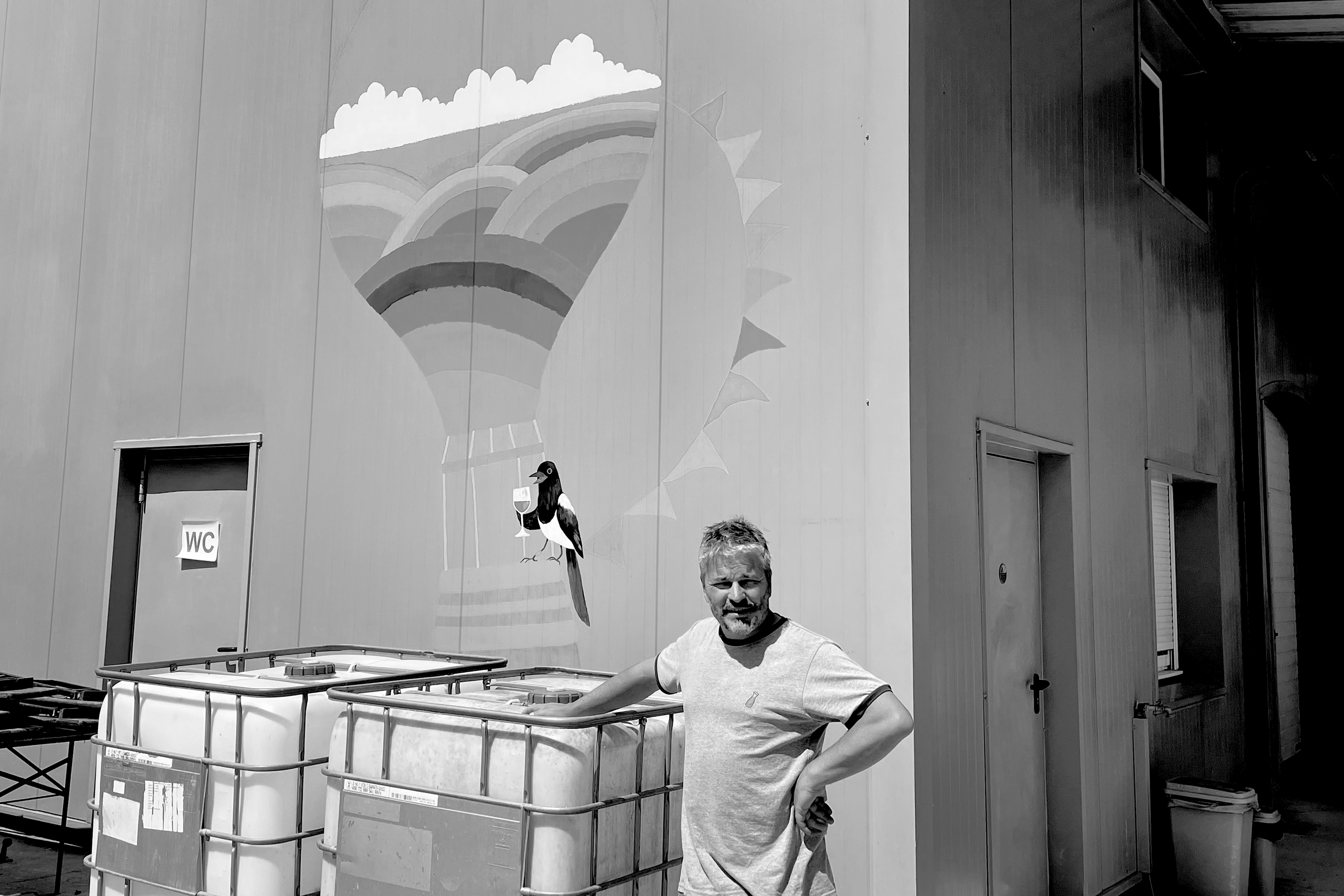
The sun is high in the sky, throwing a blanket of shimmering heat haze across the town of Chinon and its vineyards. Dressed for the weather in an unfussy grey t-shirt, blue shorts and rather smart M. Moustache trainers, made from eco-responsible suede and recycled materials, Jérôme Billard pauses for a moment beneath a freshly painted mural of a hot air balloon. It is a suitable image for the end wall of his cellars, which sit only a stone's throw from the banks of the Vienne; Montgolfiers, as they are sometimes referred to in France, a nod to hot air balloon pioneers Joseph-Michel and Jacques-Étienne Montgolfier, are frequent sights over the valleys of the Loire and its tributaries. After all, what better way to view the great châteaux of this region than from the air?
And yet, while I admire it, I am not here to make an appraisal of Jérôme's latest artistic initiative. Or his taste in fancy suede trainers either. I am here to make, with Jérôme's help, a deep dive into an under-appreciated facet of the Chinon appellation. Widely known for its red and rosé wines, fashioned exclusively from Cabernet Franc (Cabernet Sauvignon is also permitted, but wisely few make use of it), an increasing number of domaines in this region also turn out a white wine, made from Chenin Blanc. It is one of a surprisingly small number of appellations in the Loire where both varieties are permitted, and of these I think it is the only appellation in which Chenin plays second fiddle to its red compatriot.
Second fiddle. But not second class.
Despite being a niche interest, Jérôme Billard makes not one but two white cuvées, and they rank among the best in the appellation. On this visit to the domaine I took a seat at his table as he pulled the cork on close to twenty vintages of his leading white cuvée. Admirably, Jérôme did not hold back, resisting the temptation to select - as some might do - only a handful of the better vintages for tasting. We took a look at every vintage he has made, from grands années to petits millésimes, from perfect seasons to those blighted by frost, mildew or harvest rains. It provided a fascinating insight into the past two decades of Loire vintages, and how Jérôme's winemaking skill has evolved over this time period.
Before I launch into my account of the tasting though, I think I little background on the domaine, and on Jérôme himself, is perhaps warranted.
Domaine de la Noblaie
The domaine was essentially abandoned after the phylloxera louse swept through the region during the latter half of the 19th century, and this remained the case until it was resuscitated by Jérôme's grandfather Pierre Elie Manzagol in the 1950s. Prior to the arrival of phylloxera, however, there were centuries of viticultural and vinous history here, evidence for which is partly cartographical, partly physical.
The domaine is located on the south bank of the Vienne, and the upper vineyards offer excellent views across the river to Chinon's royal fortress. The majority of the vineyards and the cellars are nestled in a shallow dale, the Vau Breton; vau is an old French word which translates as valley, while Breton is one of Cabernet Franc's better-known synonyms. In other words, this is the 'Valley of Cabernet Franc'. If you told me it were the birthplace of the variety I might just believe you, if it were not for the fact modern genetic studies indicate its origins lie in the Basque region. Even so, the intertwining of place name and variety suggests that this valley has been planted to Cabernet Franc for a long time. Indeed, the name Vau Breton appears on the legendary Cassini map of France, on a section published by the renowned cartographer César-François Cassini de Thury (1714 - 1784) in 1765, suggesting Cabernet Franc has been planted here for at least 260 years. And probably much longer.
An exploration of Jérôme's facilities reveals more tangible evidence for the domaine's history.
While Jérôme's modern cellars - where the balloon is painted - are equipped with rows of stainless steel cuves, his laboratory and stock of bottled wines, the main feature of his original subterranean cellar is a cuve carved directly into the limestone wall. It is of course impossible to date with any accuracy, but is presumably ancient, having probably been fashioned during the Middle Ages, certainly long before Cassini's time. Jérôme believes it dates to the time of the Knights Templar, and given that one of his top two parcels of vines is named Les Blancs Manteaux - a reference to the white capes these religious soldiers wore - he may well be right.
The Manzagol Rescue
As noted above it was Jérôme's grandfather Pierre Elie Manzagol who rescued the domaine, after he arrived in the region from Corrèze, a notoriously impoverished corner of France. He was not the only Frenchman to leave Corrèze to escape the shackles of rural subsistence farming; other refugees from the same region included Jean Moueix, who ended up settling in Libourne. His grandsons - Christian and Jean-François Moueix - now own some of the most prestigious properties in Pomerol and St Emilion, including Petrus and Bélair-Monange.
Indeed, it seems the Manzagol-Billard and Moueix families are distant cousins, linked through another well-known Corrèzian dynasty, the Monange family. Delving into Jérôme's family tree both his grandmother (Jacqueline) and great great great grandmother (Anne) were daughters of the Monange clan, while the grandmother of Christian Moueix was another Monange (Anne-Adèle). This Corrèzian heritage is reflected in the name of Jérôme's sparkling wine Monange, and in the Christian Moueix's addition of the Monange suffix to create Château Bélair-Monange in 2008.
Pierre Elie Manzagol started out with just a few hectares of vines, releasing his first vintage in 1953. Even at this very early stage he had both Cabernet Franc and Chenin Blanc planted, and these vines were later handed down to his son-in-law, François Billard. Originally from Bordeaux, and an engineer by trade, François continued with both the red and white vineyards, expanding the domaine to 12 hectares during his tenure. He produced two wines, one white and one red, both sold under the name Domaine de la Noblaie; this was the state of play when he handed it over to his son Jérôme, shortly after the turn of the century.
Jérôme Billard
Formally trained in viticulture and oenology in Dijon, Jérôme's his first jobs after graduation were in the cellars of Petrus in Pomerol, and Dominus in California (putting his family connections to good use, I see). He returned home to take over the family domaine in 2003, quickly commissioning a soil study from René Morlat, of the Institut National de la Recherche Agronomique, to better understand what he was taking on.
He began shifting the domaine into organics on a parcel-by-parcel basis, completing the transition and securing organic certification in 2011. Shortly afterwards came those new cellars (although the mural is a much more recent addition), construction of which he directed alongside his father; they were completed in time for the 2012 harvest, although only fully operational in 2013. Judging by the leap forward in quality of the wines which followed, their completion was a significant moment in the history of the domaine.
Jérôme was keen to introduce a little more precision into the portfolio of wines, both red and white. He now regularly bottles four red cuvées, and two white; I will deal with just the white wines here.
The Noblaie Whites
"In my grandfather's time it was only him, Ligré and Raffault making white wine," Jérôme once told me. Château de Ligré is a historic property located south of Vau Breton, close to the periphery of the Chinon appellation, which these days seems to maintain a very low profile. Raffault - specifically Olga Raffault - is rather better known, and here there is even a parcel of vines named Champ-Chenin (literally, Chenin-Field), testament to this variety's longstanding presence in the appellation.
"My grandfather always continued with it," continued Jérôme, referring to the white wine, "as he felt it was an important part of Chinon's vinous heritage."
Important, but still niche. The modern-day Chinon appellation, which was expanded in 2016, now covers 2,400 hectares. Of these just 105 hectares are planted to Chenin Blanc, a mere 4.4% of the appellation. Of these 5.4 hectares are at Domaine de la Noblaie, about one-fifth of the 25-hectare domaine. There are currently another 27 hectares planned for the appellation as a whole, but even after this expansion the area dedicated to Chenin will still only account for less than 6% of the vineyard. Most domaines still tend exclusively Cabernet Franc, but those that do have some Chenin make the most of it; a surprising number manage to eke two cuvées from their small parcels, including Charles Joguet, Olga Raffault, Fabrice Gasnier and Bernard Baudry.
And, of course, Domaine de la Noblaie.
As soon as Jérôme took over from his father he divided the white harvest to create two cuvées. The first, vinified in stainless steel, has profoundly clean lines and a classically taut Ligérian style, and it can be viewed as the descendent of the original Noblaie cuvée his father made. It has gone by a couple of different names over the years, but has been sold as Chante le Vent since the 2017 vintage.
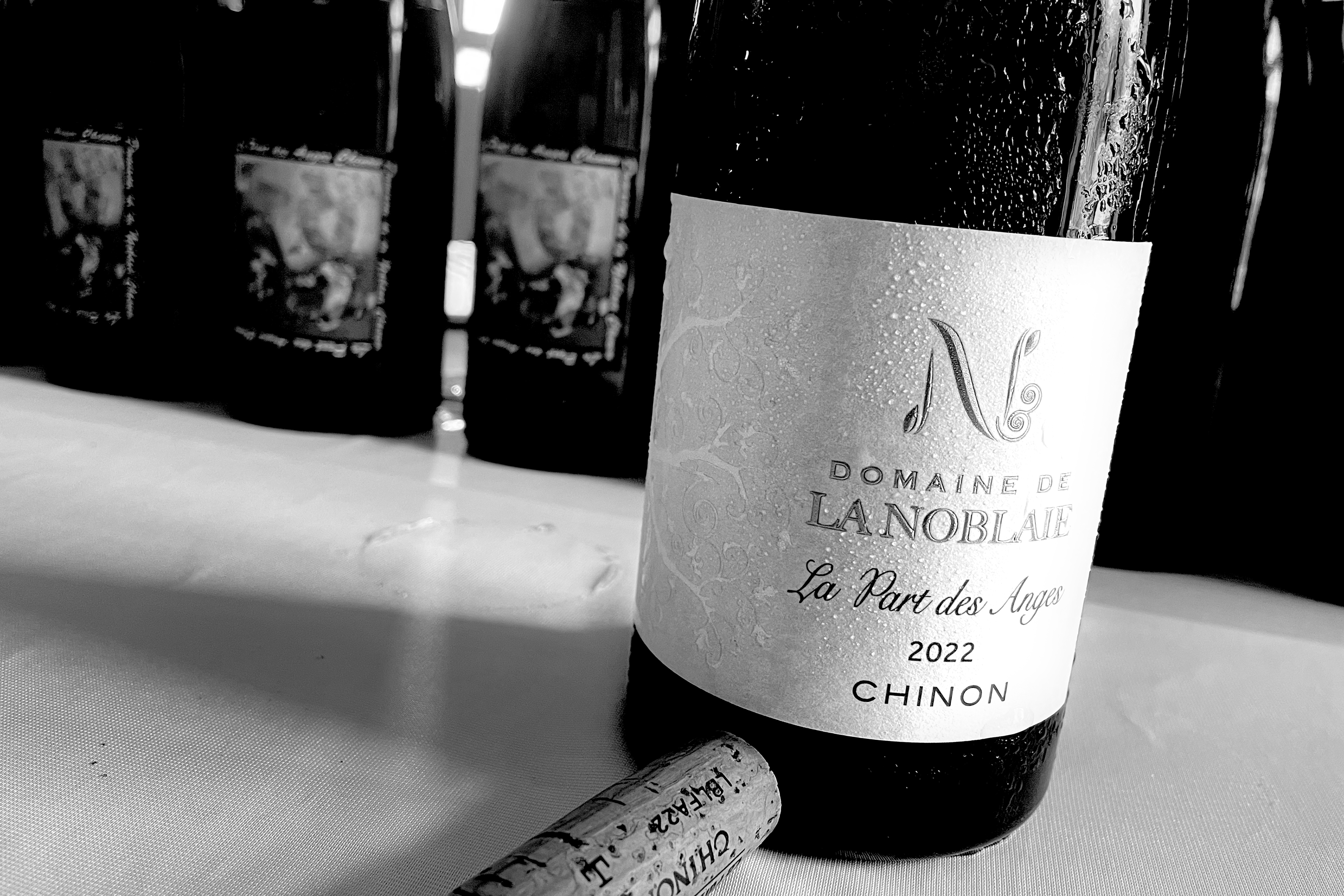
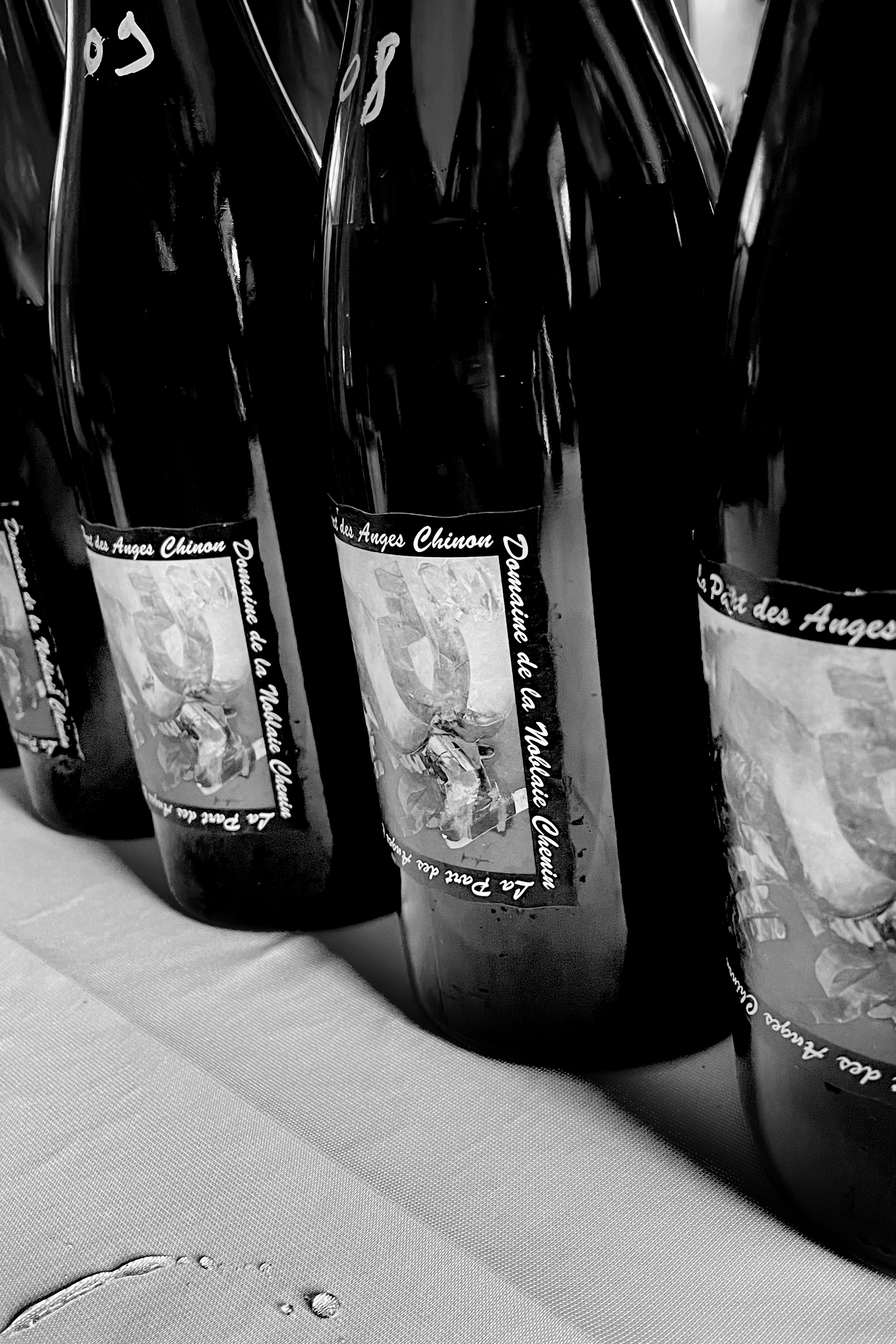
With the second, much smaller slice of the harvest Jérôme began to experiment, creating in the process his second white cuvée, the barrel-fermented La Part des Anges. In this report I take a look at these wines, from the 2003 vintage through to 2022.
La Part des Anges
"In 2003 I produced four barrels of the experimental white, one of which was a direct press cuvée which is what I called La Part des Anges. The others were a skin-contact wine, with 24 hours of maceration, and another was a late-harvest sweet wine. I honestly don’t remember what the fourth barrel was," confessed Jérôme.
So the inaugural vintage of La Part des Anges came from a single new 225-litre barrel, and given the vintage - which was exciting for reds, but questionable for whites - I approached this with one with caution. But the 2003 La Part des Anges is a decent result for the vintage, even if it does present a rather old-school, golden facade, with a lush texture which speaks of the warmer season. It was superior to the 2004 vintage, which Jérôme recalls as a very dry vintage through summer, followed by significant rainfall right through harvest. And it also came out ahead of the 2007, which has developed down a rather oxidative line.
The one vintage in this line-up Jérôme couldn't show me was the 2006. "I don't understand it - I simply couldn't find any bottles," he explained. Disappearing for a few minutes, he returned armed with a huge lever-arch file, the domaine's memory. Thumbing through the sheets, he discovered the reason. "Ah, that's why. We only produced 891 bottles. And we sold them all."
Two vintages from this early era trumped the 2003; these were the 2005, with sweet fruit and Chenin bitterness finely interwoven, and - much to my surprise - the 2008 vintage, which was fresh and bright in the glass. "It was an anticyclone year, with a late harvest, and very golden skins," mused Jérôme. If this is the result, bring on the anticyclones; the 2008 was a delicious tour de force.
After this came a string of vintages that did not show so well, with the wines of 2009 through to 2013 all showing their age. "I was using more sulphites up to 2008," explained Jérôme, "which might be relevant." Not only does restricted sulphite use open the door to a different aging trajectory, it also facilitates the malolactic fermentation, which was a feature from this point onwards. Of the five wines, the 2012 came out on top, with the wine of the hot 2010 vintage, now all burnished bronze and laden with notes of sweet pastries, the weaker member of this quintet.
And then came the new cellars, built by Jérôme and his father, partly in use in 2012, fully up-and-running in 2013. The sulphite additions remained modest (comparable in these vintages to the doses in 2009, 2010 and 2011), and the malolactic fermentation was now a regular feature of the vinifications, and yet from 2014 onwards the wines are more tense, bright and pure.
I asked Jérôme why this might be.
"Firstly it is the new cellars - up until this point I had been making wine in suboptimal conditions, sometimes even doing the fermentations in the courtyard, but now I had dedicated purpose-built facilities. I also introduced more 500-litre barrels at around this time, replacing the smaller wood, and I began working in a more reductive style. And in 2018 I introduced a single 11-hectolitre foudre into the mix. But the most important change was being able to use the new cellars."
The results are plain to see; the 2014 vintage was the turning point, the style suddenly fresh and harmonious, perhaps de rigueur for the vintage which was blessed with bright and incisive acidity, but the wine was better again in 2015, not what I would have expected, similarly strong in 2016, 2017 and 2020, and even better again in 2019. Along the way Jérôme began to wind back the time in oak, in the hunt for more tension and linearity, blending the wine after one year in barrel, and then leaving it to rest in stainless steel tank for another year before bottling.
And while the 2017, 2021 and 2022 vintages showed that there is quality here even in more challenging frosted or drought-bitten seasons, it was the memory of the 2019 that lingered longest in my mind once the tasting was done. That, and the memory of that hot air balloon mural, which reminds me that I really should book a ride in one over the Loire one day. Oh, and the realisation that I need to trade in my old trainers for something smarter - perhaps in eco-responsible suede.
–
Article, Reviews and Photography by Chris Kissack

PRODUCERS IN THIS ARTICLE
> Show all wines sorted by scoreMore articles
Château Le Dôme 1997-2022
10th Sep 2026
9 tasting notes
Bordeaux 2024 Revisited
03rd Sep 2026
69 tasting notes
Château Jean Faure 2004-2023
10th Jul 2026
10 tasting notes
Bordeaux 2025 En Primeur
07th May 2026
382 tasting notes
Show all articles