06th Feb 2025
You may ask yourself, "What is that beautiful house?"
You may ask yourself, "Where does that highway go to?"
And you may ask yourself, "Am I right, am I wrong?"
And you may say to yourself, "My God, what have I done?"
Once in a Lifetime, The Talking Heads
Once in a Lifetime
2023 was a growing season anomaly for Napa Valley. It was cool—similar to 2011 but without the harvest rains. Following a series of vintages dogged by heat domes, winemakers in Napa spent much of the summer of 2023 bracing for a scorching heat event that never transpired. Only a single day barely tipped 100 degrees F in early July. Otherwise, daytime highs were firmly in the 80s and 90s. On top of the relatively cool temperatures, the valley returned to the foggy summer mornings of yore. Most areas were regularly blanketed with mist from early morning until 10 or 11 a.m.; sometimes, the sun didn’t break through until afternoon. In the run-up to harvest, more than a few growers were panicking that the fruit might not achieve full ripeness. Fortunately, the weather turned slightly warmer and sunnier coming into autumn, and it remained dry. Those who had their yields in balance were well-placed to just go with the flow and wait for ripeness. As the fruit began rolling in across the valley, there were whispers of a “once in a lifetime” vintage. Having tasted hundreds of 2023 barrel samples by now and comparing these to all Napa vintages I’ve tasted going back through the 1960s, they might just be right.
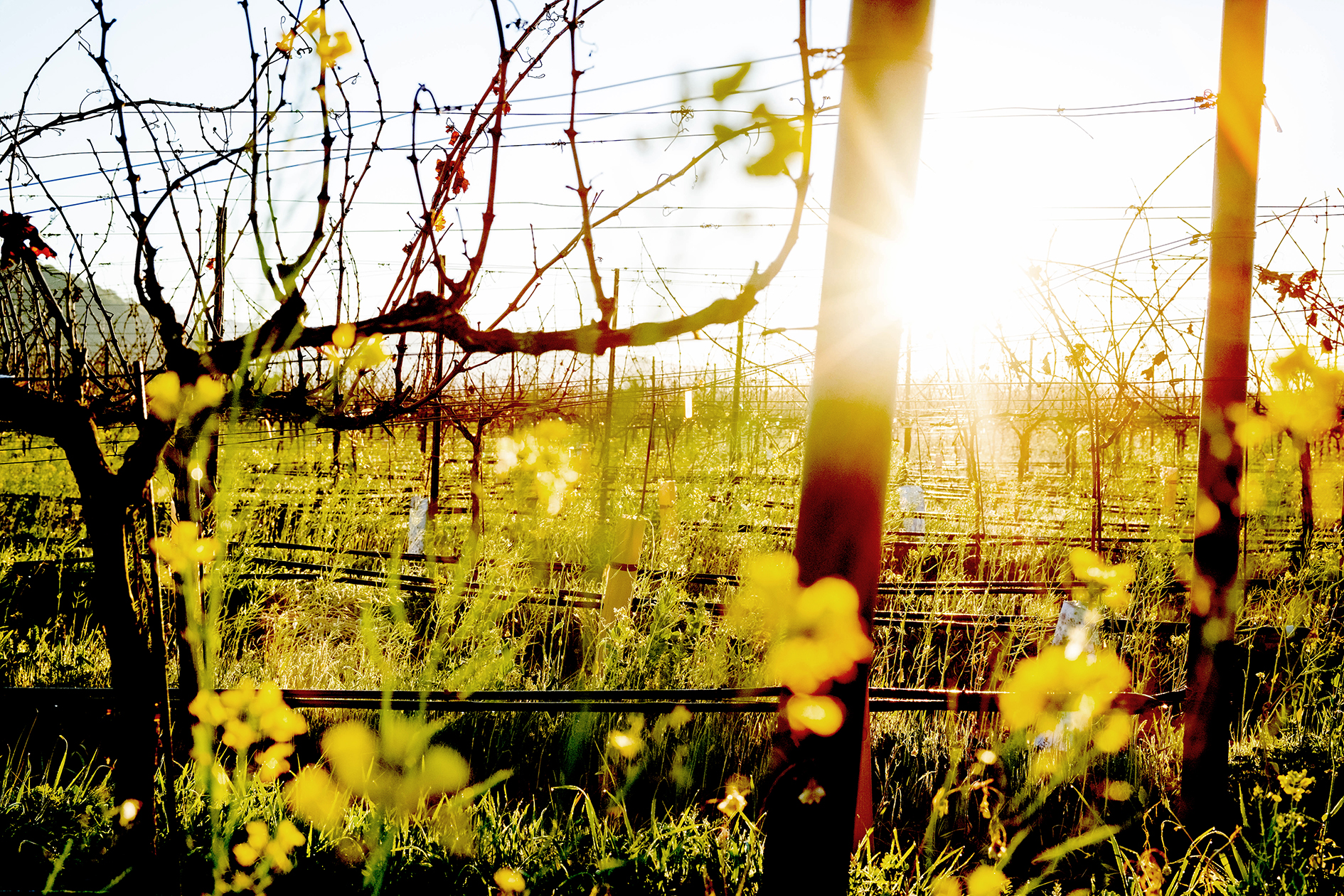
The 2023 Napa Valley growing season began with a late budburst, starting from early April for Chardonnay and mid-April for Cabernet Sauvignon (late March is the norm). A very wet winter and cool spring kept the vines dormant for a couple of weeks longer than usual, so everything was tracking late from the get-go.
“After the relentless heat of 2022, the 2023 vintage felt like a deep breath of fresh air,” recalled Tod Mostero, technical director at Dominus Estate. “It was one of the latest vintages on record, beginning with an exceptionally wet winter—51 inches of rain, compared to a historical average of 31 inches, making it one of the wettest seasons in recent memory. This moisture, combined with a cold spring—June saw the coldest average temperatures since 1998—delayed every stage of development by about two weeks. Budbreak, bloom, and veraison all set records for lateness.”
Weather conditions were near-ideal for bloom and fruit set, allowing for a potentially hefty crop. However, given the cooler conditions, the bunches ultimately needed thinning to achieve physiological ripeness.
June, July, and August were just moderate in terms of heat and sunshine. Many mornings started out foggy, keeping conditions cool until around 11 a.m. each day, further slowing berry development.
“2023 stands out for how moderate the entire season was,” said Spottswoode’s winemaker Aron Weinkauf. “I don't think we broke 100 degrees the entire year. It was not hugely different than 2011, except we never had the rains. With whites and reds, you had such a luxury dialing in your pick times. Some vintages are like triage, but this was a vintage with too many choices. We could easily build in structure and texture. We had great acidities, so there was no fighting the pHs. Yields were average to above average. Vine health was great. 2023 was unbelievably accommodating compared to the vintages around it.”
It proved a late harvest for both white and red varieties. The white grapes for still wines began trickling in from early September.
“The 2023 Chardonnays are some of the best I've ever made,” said Mark Aubert. “It's the vintage. As long as you were very diligent with yields, you could get amazing flavor and intensity in 2023. It was like a long piece of music. Our average hang time was 2 to 4 weeks longer than usual.”
The Cabernets needed a lot more hang time than usual, making this one of the longest growing seasons of this century—and a welcome viticultural freak of nature in our era of climate change. Winemakers were tested on their ability to do nothing during mid-September when their wineries would normally be a hive of activity.
“Ultimately, I think some 2023s were under-extracted because it was too cool and some people harvested too early,” said winemaking consultant Jean Hoefilger. “We harvested mostly in October and early November. 2023 was for me right up there with the best vintages that I have ever made in Napa.”
Jean raises a good point. While elegance, brightness, and purity are signatures of the vintage—appealing to the palates of many modern Cabernet lovers—a few of the wines I’ve tasted are little on the light, soft, and lean side. Patience paid off for sure in 2023. Growers who waited well into October to harvest had luck on their side—the weather turned warmer and sunnier, providing that ideal push for the berries to reach optimal ripeness.
Although the 2023 harvest was late, it turned out to be a winemaker’s dream in terms of wine style.
“What truly defined the season was its consistency,” said Tod Mostero. “Summer temperatures were warm but steady, without heat spikes—no drought stress, no sunburn, no water deficits. We saw only a handful of days above 92°F, a rarity in recent years. Fall felt like a classic Bordeaux autumn—crisp, cool, and fresh—which shaped the fruit in an extraordinary way. The berries were vibrant and structured, with remarkable clarity and lift. Once fermented, the wines displayed an electric tension between freshness and depth, with an inner brightness that sets them apart.”
Indeed, the in-coming fruit possessed remarkable energy.
A good portion of the Cabernet Sauvignon crop was in by mid-October, but many sites required more hang time to achieve full physiological ripeness. Meanwhile, because sugar accumulation and phenolic/flavor ripeness were tracking at a relatively even pace, the alcohol levels of many 2023 Cabernets are lower than typical, mostly below 15% and with many coming in under 14.5%.
“2023 was the first vintage since 2019 that we didn't have any climate or weather constraints,” said Maya Dalla Valle. “We could do more extraction and still have wines of great elegance.”
As mentioned, potential yields were looking optimistic in the run-up to veraison, and it was essential to drop fruit early to match the moderate sun and heat resources of 2023 in order to achieve optimal tannin ripeness. This is not to say that winemakers could not have their cake and eat it too.
“Then came the sheer abundance,” Tod Mostero pointed out. “After years of small crops, 2023 was a true cornucopia—breaking yield records and filling the cellar to capacity. But it wasn’t just about volume; every lot showed consistent balance and depth.”
Overall, 2023 yields across the valley are reported to have been up by 10 to 15% on average, meaning there is more to go around for this once-in-a-lifetime vintage.
“I’m eager to see how these wines evolve,” added Tod. “But right now, the 2023s feel like a return to something timeless—classic structure, natural vibrancy, and the quiet power of an unhurried, generous season.”
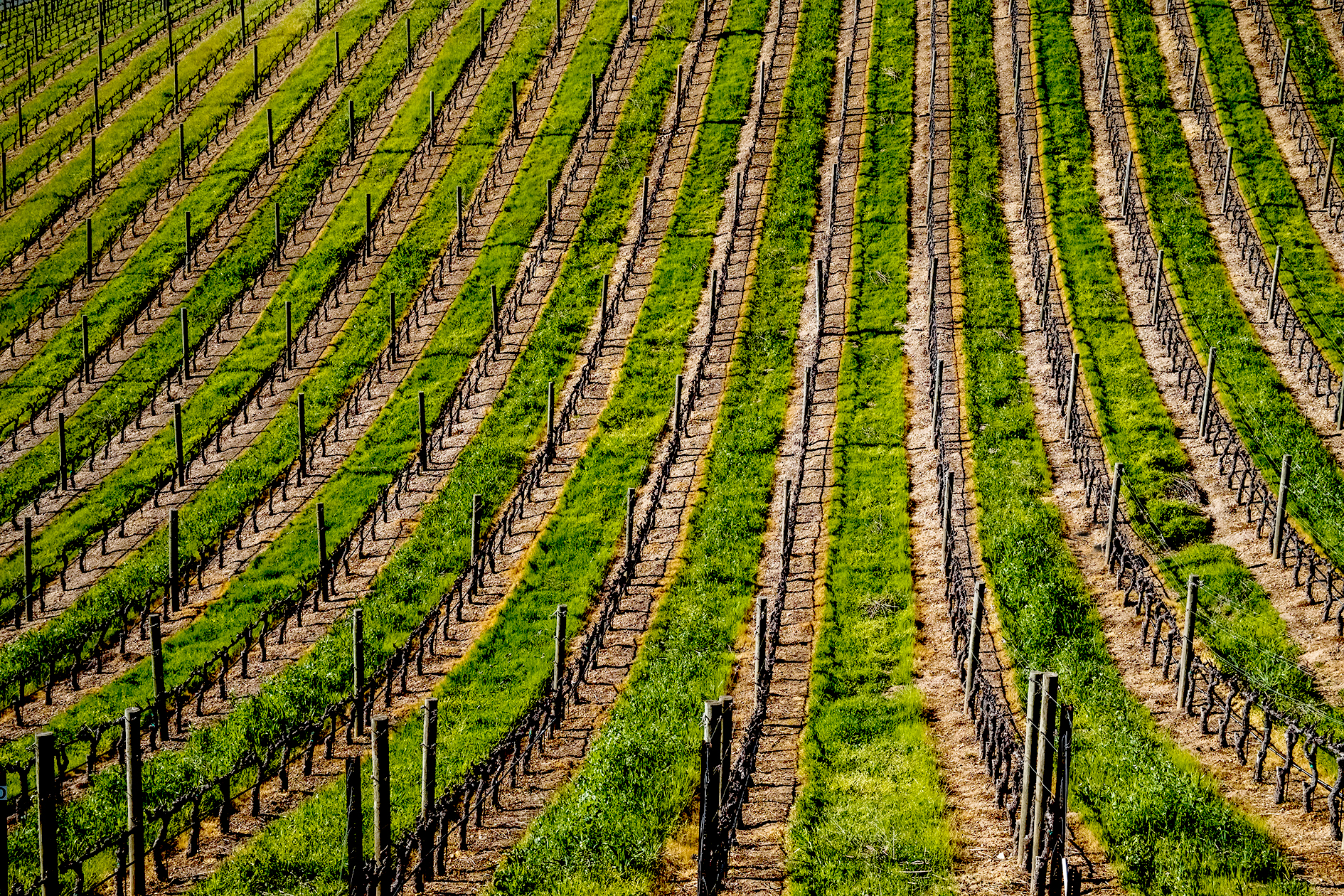
A First Look at 2024:
And now for something completely different.
2024 is potentially a very good to excellent vintage, but the growing season was not without its curveballs. The significant difference compared to 2023 is that 2024 was much hotter. In some areas of the valley, more than thirty days from June through October exceeded 100 degrees F. This year, the sustained heat waves especially affected vines in July—pre-veraison and during veraison.
“In 2024, the heat in July was hard,” Aron from Spottswoode told me. “It just went on. It created a wide spectrum of reactions across the vines. There’s a lot of variability. The early heat spells affected vines very differently. Areas that we usually harvest earlier were later, and vice versa. We had some blocks where one was 20 brix and the other was 25 brix. Some of the vines were very slow to progress. In some areas, the veraison was very quick and even, others not. Sugar was outpacing physiological ripeness in many cases; in other cases, stunted vines didn’t have much sugar accumulation.”
So, it wasn’t just the number of extremely hot days in 2024 that caught growers off-guard and made for a bumpy ripening road. It was when they occurred. Winemakers are prepared for heat in late August and early September—in the run-up to harvest. But the extreme heat in June and July made some vines sluggish early on, accounting for uneven ripening. Diligent growers picked up on this and marked blocks and/or individual vines that were adversely affected, harvesting these separately/later. However, not everyone was so on-the-ball about the situation, while others simply did not have the resources to react.
The harvest period in 2024 was generally about 2-3 weeks earlier than in 2023, thanks partly to the earlier budbreak but also because it was warmer and sunnier. This turned out to be a blessing because the first couple of weeks of October were afflicted by yet another scorching heatwave—incredibly unusual this late in the season. In St. Helena, daytime temperatures from October 1st through the 8th held at over 100 degrees F. Fortunately, most growers had their fruit in by late September. Those still hanging fruit scrambled to harvest as soon as they saw the forecast. Unfortunately, bunches left on the vines during that October heat event were mostly fried to raisins.
I’ve tasted just a few 2024s from barrel, and the styles appear to be more "classic Napa" than 2023. The wines I’ve sampled are opulent and generous, with bags of black fruit and solid backbones. There are some absolute 2024 head-turners in the making, but I’m expecting a little more inconsistency than recent great "classic" vintages like 2019 and 2021.
-
Article & Reviews by Lisa Perrotti-Brown MW
Photography by Johan Berglund

PRODUCERS IN THIS ARTICLE
> Show all wines sorted by scoreMore articles
Château Le Dôme 1997-2022
10th Sep 2026
9 tasting notes

Bordeaux 2024 Revisited
03rd Sep 2026
69 tasting notes
Château Jean Faure 2004-2023
10th Jul 2026
10 tasting notes
Bordeaux 2025 En Primeur
07th May 2026
382 tasting notes
Show all articles