14th Nov 2024
I recently had the opportunity to taste the current releases (and a few older vintages) from Perelada Winery with USA importer Eymeric Darsch of Vinovia. Perelada is not just a winery; it’s a castle in Empordà, Catalonia, dating back to the 13th Century—Castell de Peralada. From the 14th Century, the castle was occupied by monks who made wine. In 1923, Miguel Mateu bought the castle and decided to revive its winemaking heritage.
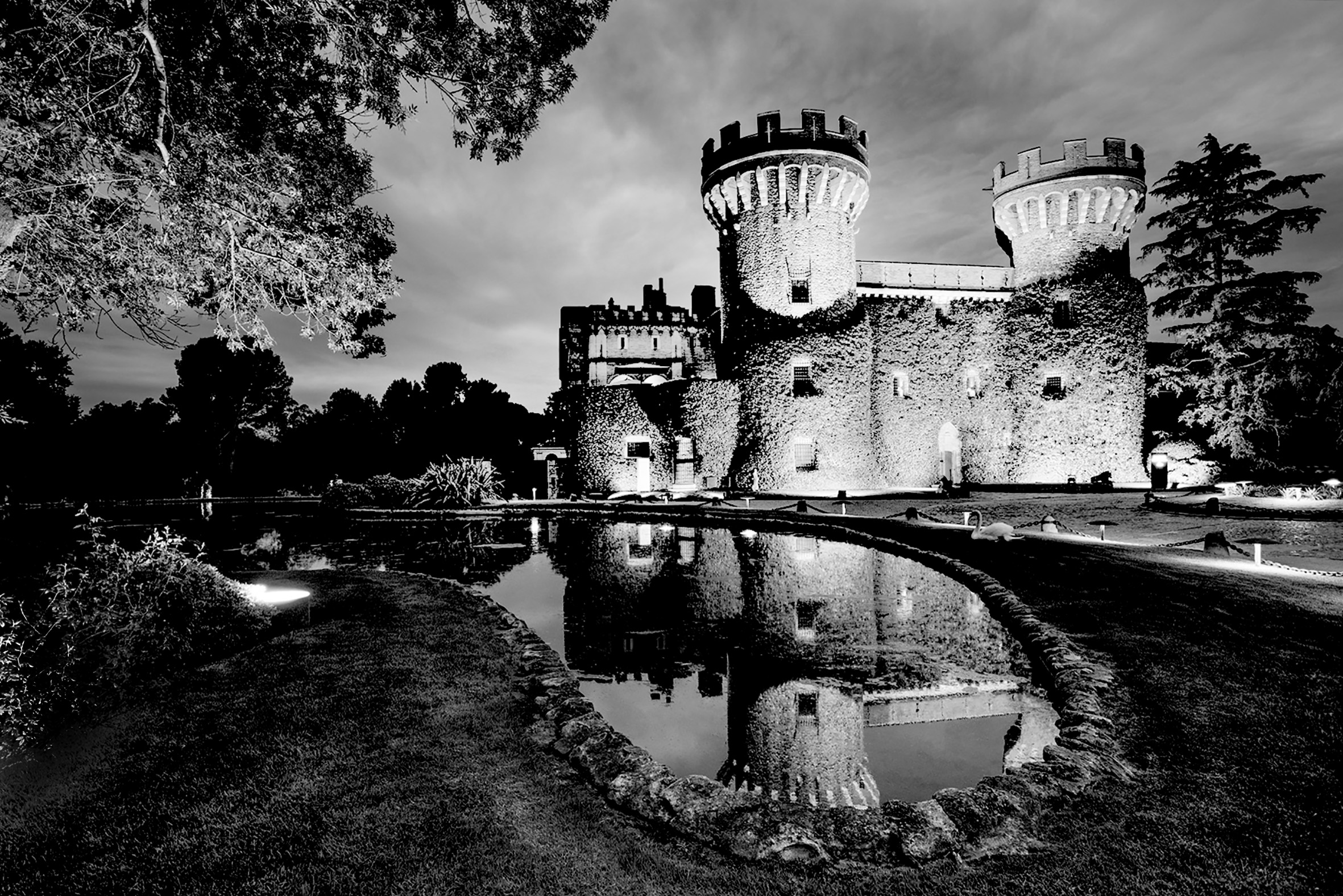
The Castle
“Miguel Mateu was a huge art collector,” Eymeric Darsch recounted as we sat to taste. “He needed a summer home, so he bought the castle in Empordà. The Carmelite monks who occupied the castle before made wine to supply the region, and Miguel wanted to continue that tradition.”
Miguel Mateu renovated the castle and developed it into a cultural center, amassing the art collections that would become the castle museum. His daughter and son-in-law, Carmen Mateu and Arturo Suqué, took over the management of Peralada in 1972. It was their dream to develop Peralada Castle into one of Spain’s top wineries. Today, the third generation, led by Javier Suqué Mateu, runs the estate and is committed to its ongoing development and innovation, purchasing and planting new vineyards while maintaining a state-of-the-art winery.
Perelada’s winery and vineyards are located in Catalonia, in the northeastern corner of Spain, where the Pyrenees mountains meet the Mediterranean Sea. Production is exclusively from estate-grown fruit. They offer a portfolio of terroir-expressive table wines and a range of great-value Cavas.
Devoted to the table wines, there are over 130 hectares (321 acres) of vines owned by the estate, distributed across five diverse vineyard sites: Finca Garbet, Finca Espolla, Finca Malaveina, Pont de Molins, and Finca La Garriga. The vineyards are in the northern part of the Empordà D.O., where the cold, northeasterly Tramuntana wind is strongest. There is a wide variety of soil types, including slates, sands, river sediments, clay loams, and gravels. The wines showcase the heterogeneity of the terroirs.
Finca Garbet encompasses 12.8 hectares of mountainous terrain with slate-based soils, bordering the Mediterranean Sea and requiring planting on terraces. This site is only 5 kilometers from the border of France. “This is overlooking the ocean,” said Eymeric. “The very strong winds mean the vines are very slow growing. The vineyard is planted to multiple grape varieties, so the blend for this wine changes.” Major plantings here include Syrah, Cabernet Sauvignon, and Garnacha (Grenache).
Finca Espolla is 21 hectares, located in Las Alberes within the Pyrenees foothills. Mainly Syrah and Monastrell (Mourvèdre) are planted here on soils of broken slate.
Finca Malaveina has 19 hectares of mainly Merlot, Cabernet Sauvignon, Cabernet Franc, and Garnatxa Negra (Grenache), planted amidst spectacular views of the Mediterranean and the Pyrenees. These are reddish clay slopes with underlying gravel to facilitate natural drainage. “This is the closest vineyard to the castle,” said Eymeric. “Malaveina is an old Catalan word. It literally meant ‘the bad lady’ who lived on the edge of the village. Men loved her, and women hated her—she was a lady of the night.”
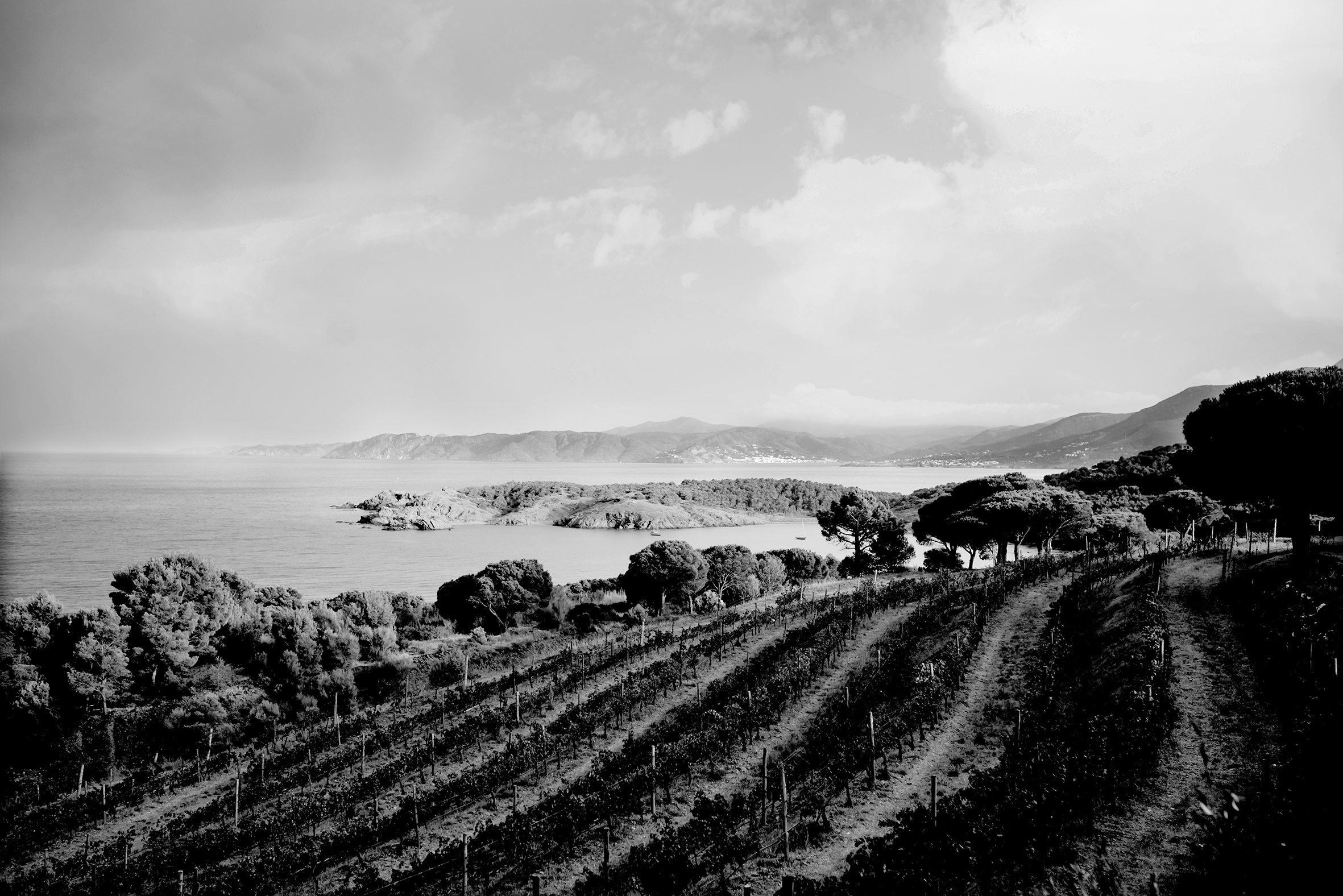
Pont de Molins has 37 hectares of vines, most over 30 years old. Finca la Garriga is 41 hectares of the oldest vineyards in Perelada, over 60 years old. The main varieties here are Samso (Carignan) and Chardonnay. The soils are a mix of clay and gravel.
Perelada’s great value (under $20 a bottle) “5 Fincas” label is a blend from all five vineyards. Around 200,000 bottles are made annually. “This wine is really the backbone of the winery,” said Eymeric.
"Ex Ex" is a unique label made by Perelada, dedicated to experimental grape varieties.
“Perelada was appointed by the D.O. to conduct research and development on behalf of the Emporda,” said Eymeric. “Therefore, the Ex Ex wines are made from varieties not necessarily approved by the D.O.”
Each vintage of Ex Ex is numbered. The first “Ex Ex 1” was made in 1998 and is a blend of 60% Cabernet Sauvignon, 25% Merlot, and 15% Garnacha. The current 2019 Ex Ex 14 release is 100% Garnacha.
"The Perelada Cavas are of very high quality at a terrific price point," said Eymeric.
He’s not wrong. Last week, I highlighted the 2022 Castillo Perelada Stars Touch of Rosé Brut, Spain, Cava, Penedes as one of my top pick value wines for the holidays, retailing at just $13!
Finca l’Almirall is Perelada’s estate dedicated to Cava production. This is comprised of 73 hectares (180 acres) of vines, all organically farmed in the Castellví de la Marca in the Alt Penedès, a region best known for its Cavas. The vines here are over 60 years old, including indigenous and international varieties.
“Cava production this year is down 30% because of the drought in Spain,” Eymeric pointed out. “So, unfortunately, we have a lot of demand, but we don't have much stock.”
Casa Gran del Siurana, Priorat
Casa Gran del Siurana in Priorat is a separate estate also owned by the Mateu family.
“Siurana is the river,” Eymeric told me. “Casa Gran del Siurana means ‘the big house on the river.’ Casa Gran was created from scratch in 2000 as a lifelong project of Javier Suqué Mateu with a goal to become one of the most progressive wineries in Priorat for research and becoming among the most iconic wines.”
On the outskirts of Bellmunt del Priorat, on the banks of the River Siurana, stands the property locally known as Casa Gran. This historic, three-hundred-year-old building was previously home to the Carthusian monks of Scala Dei, the monastic order that introduced viticulture into the area in the 12th Century. The monks were famous not only for their wines but also for their strict vows of silence. The property surrounding Casa Gran now forms part of the estate’s vineyards.
As at Perelada, all the Casa Gran del Siurana wines are made from estate fruit. The property consists of two vineyards: La Casa Gran (surrounding the winery) and La Fredat.
The La Casa Gran vineyard has 16.5 ha planted with a combination of local (Garnatxa/Grenache and Carignan) and international (Syrah, Cabernet Sauvignon, and Merlot) grape varieties.
La Fredat is a very hilly 38-hectare estate with 9.82 hectares of vines planted on terraces. The grape varieties include Garnatxa (Grenache), Samsó (Carignan), Cabernet Sauvignon, and Syrah. The soil type here is “Llicorella,” typical of Priorat, formed from fragmented slate mixed with small particles of quartz.
The wines of Casa Gran del Siurana are typically powerful expressions of Priorat, skillfully managing to evoke purity and freshness. I particularly love the 2020 La Fredat, a brand-new wine from the estate. It comes from a small sub-block of the La Fredat vineyard and is made from 100% Grenache. Dense with red berry and spicy layers framed by satiny tannins and wonderful freshness, it finishes with an orange peel lift—perfect for the holidays!
-
Article & Reviews by Lisa Perrotti-Brown

PRODUCERS IN THIS ARTICLE
> Show all wines sorted by scoreMore articles
Château Le Dôme 1997-2022
10th Sep 2026
9 tasting notes

Bordeaux 2024 Revisited
03rd Sep 2026
69 tasting notes
Château Jean Faure 2004-2023
10th Jul 2026
10 tasting notes
Bordeaux 2025 En Primeur
07th May 2026
382 tasting notes
Show all articles