13th Mar 2025
It’s my first visit to Quilceda Creek, and I’m confused. Google Maps has led me to what appears to be a quiet family neighborhood in the suburbs of Seattle. The place is awash with perfectly manicured lawns, colonial-style houses, and two-car garages. I check the address I’ve punched in; it’s correct. I turn into the drive and clock what looks like an office of sorts, but no winery or vineyards. I continue driving up to the main house, realize it is just a house and garage, turn around, and head back to the office. A doormat welcomes me to Quilceda Creek. Peering through the window, I spot a vertical of familiar labels. Beyond the office, I can just make out a winding path leading to a large, modern winemaking facility tucked out of sight of the cozy neighboring homes.
Quilceda Creek is a home winemaker’s dream of grandeur come true.

Dream of Grandeur
“Paul's parents bought this house when they moved to Washington and they started dabbling with home winemaking here,” winemaker Mark Kaigas tells me as we walk up to the house purchased by Alex and Jeanette Golitzin in the late 1960s. Their son, Paul, is now the president and director of winemaking at Quilceda Creek. “Paul's great uncle was André Tchelistcheff. He gave them a lot of encouragement and advice in the early days. They used to make wine in that garage and then expanded it.” He points to what looks like an ordinary garage/work shed. “This was their first winery.”
That garage was the modest beginning of what is today one of Washington State’s most famous wineries. In the early 1970s, self-taught, home winemaker Alex Golitzin made a barrel of Cabernet Sauvignon in this garage each year using purchased grapes. Then, in 1978, Alex and Jeanette established Quilceda Creek as a bonded winery—the twelfth registered in Washington State since Prohibition. For their first official vintage that year, they made 150 cases of Cabernet Sauvignon.
I asked Paul what André Tchelistcheff—the godfather of Napa Cabernet—was like.
“Andre was a charming man,” he said. “Very old school—an avid smoker with a VERY thick Russian accent. When I was young, he used to pull his coat over his head and chase me around my parent’s house. It was kind of scary and fun at the same time. Maybe that’s why I like Dracula movies so much! His best advice to us was to make Cabernet and focus on it alone. He said this will help achieve identity with your brand on a global scale if the winery is successful. Even in the 1970’s, he saw the potential for high-quality Cabernet Sauvignon grown in Washington State.”
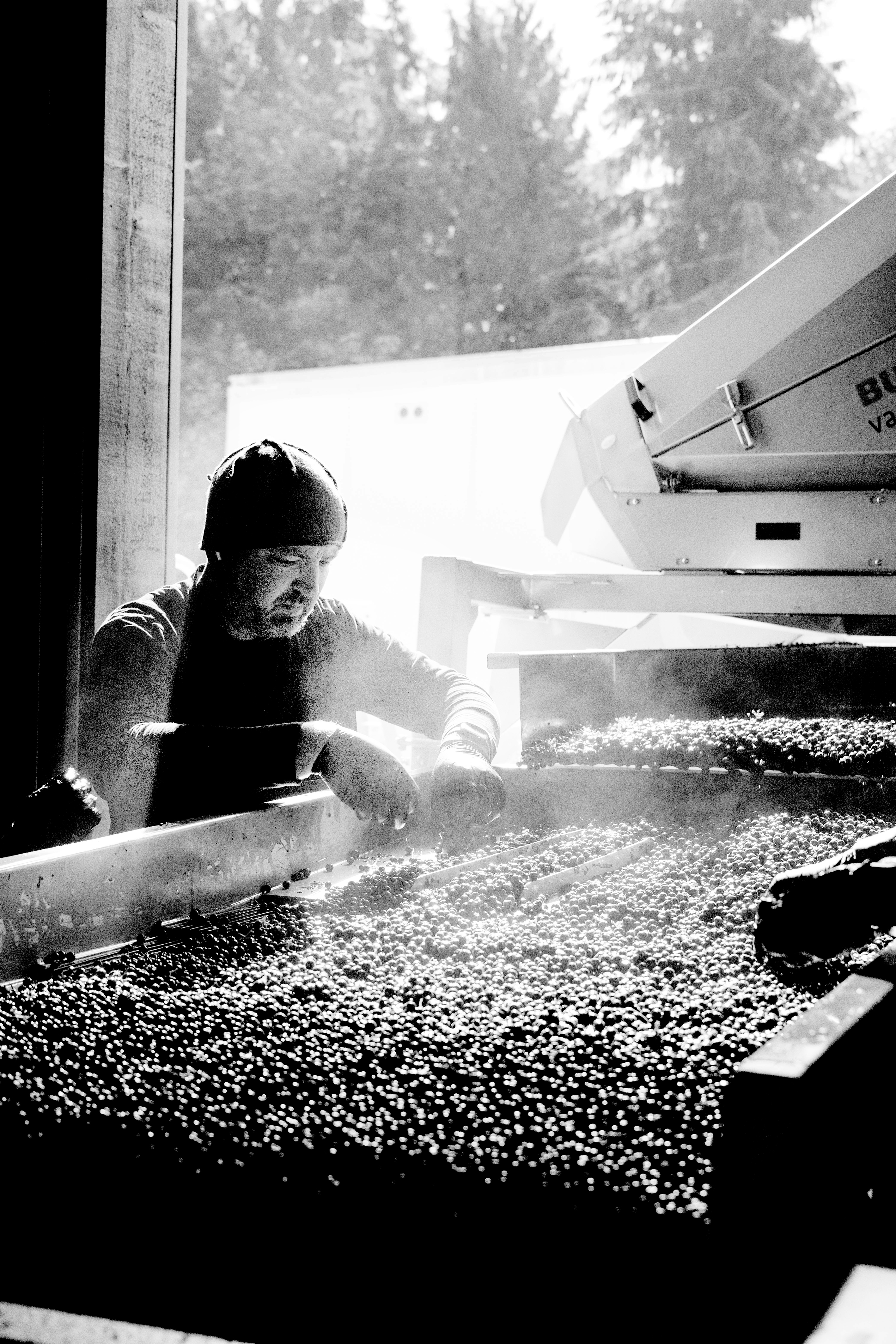
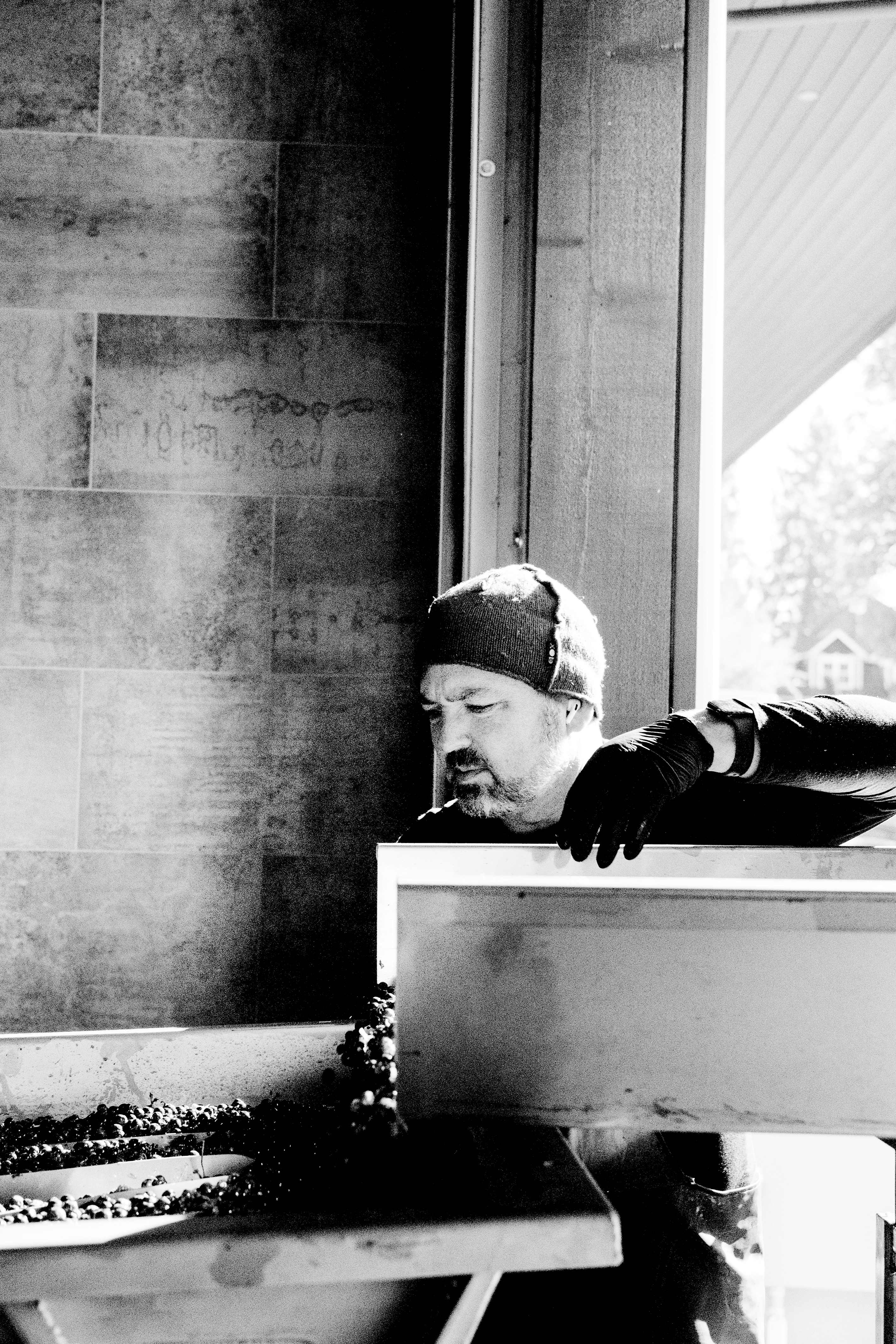
Paul grew up helping his parents make wine in their backyard and garage.
“I’ve always liked to work and thought it was normal to chip in and help out,” he told me. “I love winemaking, and that’s why I’m still doing it today. But the worst job when I was a kid was definitely washing barrels with a hot soda ash rinse followed by a cold citric acid rinse to neutralize. If you were fast, it would take about 40 minutes for each barrel.”
In 1986, Quilceda Creek began buying fruit from Champoux Vineyard in Horse Heaven Hills AVA in Columbia Valley. Champoux Vineyard, first planted in 1972, is now among Washington State’s most highly revered Cabernet Sauvignon vineyards. Today, it is also the backbone of Quilceda Creek’s flagship Columbia Valley Cabernet Sauvignon.
“Champoux Vineyard is a cool vineyard in a hot AVA,” Paul explained. “It has huge diurnal temperature swings, helping to maintain some acidity in extremely ripe grapes without ever tasting overripe. It has incredible aromatics with a strong black fruit and sandalwood character when it is at its finest. It reminds me of great vintages of Château Latour with its power, depth, and finesse. It is always the last to harvest in mid to late October. We have to have really healthy plants and run our yields extremely low to maximize the ripening power at this site. We have clones 4, 8, 191, 337, and 685 planted here.”
Quilceda Creek currently owns 79% of Champoux Vineyard.
“I have been buying more and more Champoux over time as other partners have been selling,” said Paul. “We now own 133 acres of this 169-acre vineyard. My goal has always been to be completely vertically integrated from the ground up so that we can grow all of our wines. This gives us control of the fruit, with the vision of the final wine in mind, and allows us to adapt quickly to individual growing season conditions.”
In 1992, Paul took on the position of winemaker at Quilceda Creek. In the years since, he has been instrumental in growing Quilceda Creek and improving quality, primarily by developing estate vineyards of the highest standard. In the early 2000s, he purchased and planted two remarkable vineyard sites: Galitzine and Mach One.
“Galitzine is from the Red Mountain AVA and is 100% Clone 8 Cabernet Sauvignon on a 3 x 7 planting,” he told me. “It makes a wine of great power and ripeness. It is usually the first to be harvested. I have never had trouble ripening Galitzine, and its quality has been remarkably consistent over the years with an incredible wild mountain blackberry and mineral character.
Mach One is in the Horse Heaven Hills AVA, about one hour from Champoux. All plantings here are 4 x 6. Mach One sits in a stone amphitheater of basalt and is as close as one can get to the Columbia River without going for a swim. Due to its proximity to the river, it has a very low chance of frost. Bud break is often two weeks earlier than other sites, and it has an extra two weeks on the tail end of the growing season, ensuring ripe fruit. We make two wines from this site. Palengat (Paul’s mother’s maiden name) is 100% Clone 685 Cabernet Sauvignon. I love the aromatics from this clone and often find black/purple fruit with a basalt-like stone character and lavender top notes. I feel like this clone shows more of its Cabernet Franc heritage in its expression. The Tchelistcheff label is 100% clone 412. This wine always shows savory black fruit, dried fruits, pipe tobacco, and chocolate notes with a confectionary character. I often think of red velvet cake when tasting this wine.”
I asked Paul what makes Quilceda Creek Cabernet distinct from Napa Valley or Bordeaux.
“Washington is geologically blessed,” he said. “Here, you’re able to achieve high quality regardless of vintage if you are in the right locations. We have the Cascade mountains that block most of the rain at our sites. They average 5 to 6” per year. Since all of our plants are own-rooted there is no graft damage to the plant. They are in pristine condition, which aids in their transpiration and cooling abilities. It results in true clonal variation and character to our wines.”
Back in the office with Mark, we sit to taste the new releases and a vertical of the Columbia Valley Cabernet Sauvignon going back to 1998.
“In 2002, this main building was built, which is now the tasting room,” he tells me. “In 2010, we built the big production facility behind us. And in 2019, we arrived at our current line-up.”
Like Paul, Mark cannot stress enough the importance of starting with great fruit. As Paul mentioned, a somewhat unique feature of Quilceda Creek’s vineyards is that they don’t use rootstocks. This is possible because Columbia Valley has thus far been kept phylloxera-free.
“All of our vines are own-rooted,” says Mark. “In fact, it’s much easier to grow and farm this way. You don't have to cater to each individual rootstock. We experiment with rootstocks. But we find that the grapes are nutritionally healthier, and the fruit is purer from own-rooted vines. Of course, we're very careful with tractor movement, etc., but the Columbia Valley is more remote than, say, Walla Walla. Still, you have to watch what you bring in.”
Keeping yields low is another key to achieving consistent ripeness in what Paul referred to as “a cool vineyard in a warm AVA.”
“You have to have low crop loads,” Mark says. “Two tons to the acre is about average with 4 by 7 feet spacing.”
And blending with other varieties?
"There were years in the past when our Columbia Valley Cabernet has had splashes of other varieties," he says, "but in recent years, it is 100% Cabernet Sauvignon."
As for the current 2021 releases, Mark comments, “2021 was a warmer year, a little richer, riper, and more opulent, but we still managed to capture the character of each of the wines. In 2021, a few months before harvest, the entire winemaking team got hired away, and Paul had to do most of the work with a skeleton team. Paul has been doing this his entire life, so he knew what he was doing. But it was challenging. I started here in March of 2022, so I was here to help bottle the 2021s.”
Finally, because I’ve heard it pronounced a number of different ways, I have to ask Mark for the correct pronunciation of Quilceda Creek. “It was originally a Native American name,” he says. “We pronounce it, Kwill-See-Dah.”
Currently, production of the Quilceda Creek Columbia Valley Cabernet Sauvignon is around 5,500 cases per year. This is the only label that is in distribution. The other Quilceda Creek labels are small production and sold direct to consumer via their mailing list. Mailing list members have the option of collecting to their purchases from the winery during a dedicated pick-up week. Many locals look forward to their friendly annual neighborhood visit to this home winemaker’s dream of grandeur come true.
-
Article & Reviews by Lisa Perrotti-Brown MW
Photography by Johan Berglund

PRODUCERS IN THIS ARTICLE
> Show all wines sorted by scoreMore articles
Château Le Dôme 1997-2022
10th Sep 2026
9 tasting notes

Bordeaux 2024 Revisited
03rd Sep 2026
69 tasting notes
Château Jean Faure 2004-2023
10th Jul 2026
10 tasting notes
Bordeaux 2025 En Primeur
07th May 2026
382 tasting notes
Show all articles