05th Sep 2024
During my annual trip to Oak View, California, to taste the new releases of Sine Qua Non, The Third Twin, and Next of Kyn with owners Elaine and Manfred Krankl, I thought it would be informative to check in on some of the older Sine Qua Non vintages from the early 2000s to see how they have developed. The Krankls arranged a tasting of twelve wines from 2000 to 2008, including some of their most collectible labels to date. The fruit sources, winemaking facilities, and techniques have changed over the last quarter of a century, yet Manfred Krankl's creative blending and pedal-to-the-metal style remains at the core of each singular wine from past to present. Sine Qua Non lovers know that most of the releases are out-of-the-gate decadently delicious, but is it worth cellaring these densely layered, hedonic creations, or is it better to drink them on the young side?
The Aging Conundrum
While scientific research over the last quarter of a century or so has helped us better understand what happens when wines age in bottle, there are still many unanswered questions about why some wines develop positively in a bottle over the course of years and sometimes decades, while others just fade.
The primary goals of aging wine in bottle (apart from financial speculation) are preservation and accumulation. A wine that ages well not only holds its fruit and remains drinkable over many years, but the real excitement happens when it transforms into something more than it was in its primary flushes of youth. Over time, tannins in red wines can lessen and soften in appearance. Additionally, chemical changes affect the aroma/flavor compounds, rendering some wines more complex. This is a result of the compounds responsible for the initial primary aromas of the grape, previously masked aroma precursor compounds, alcohols, acids, and those compounds resulting from fermentation (secondary aromas) interacting with each other, the dissolved oxygen in wine, and with phenolics so that over time the aromas may be transformed into profound tertiary characters. An example is the formation of aldehydes by the oxidation of various alcohols in wine (primarily ethanol).
Another common reaction contributing to complexity during maturation and bottle aging is esterification—forming esters from various combinations of alcohols and acids, adding to the range of aromas.
I've studied the wine aging conundrum most of my career. My conclusion is that there is no one formula for producing an age-worthy wine. If we just consider dry red wines, the list of possible parameters for crafting a long-lived beauty is as long as the proverbial piece of string. A solid structure (sufficient tannins and acid) is critical, but so is the intensity and nature of the fruit-derived aromatic and flavor compounds. I've heard lots of claims, even by experts, that red wines require a low pH (higher acidity) and modest alcohol to last the long haul. Still, there seems little evidence to back this up. There are plenty of legendary high pH, higher alcohol wines that have aged wonderfully, including 1947 Chateau Cheval Blanc and 1989 Château Haut-Brion.
I tasted twelve Sine Qua Non Syrahs and Grenaches produced from 2000 to 2008. When I suggested this tasting to Elaine, she asked me which wines I wanted to taste. I sent the list of the labels I was most interested in tasting, and that's what we tasted:
2000 In Flagrante Syrah
2002 Just for the Love of It Syrah
2003 Li'L E Grenache
2003 The Inaugural Syrah
2004 Ode to E Grenache
2004 Poker Face Syrah
2005 The 17th Nail in My Cranium Syrah
2005 The Naked Truth Grenache
2006 In the Crosshairs Grenache
2007 Labels Syrah
2007 Pictures Grenache
2008 The Duel Grenache
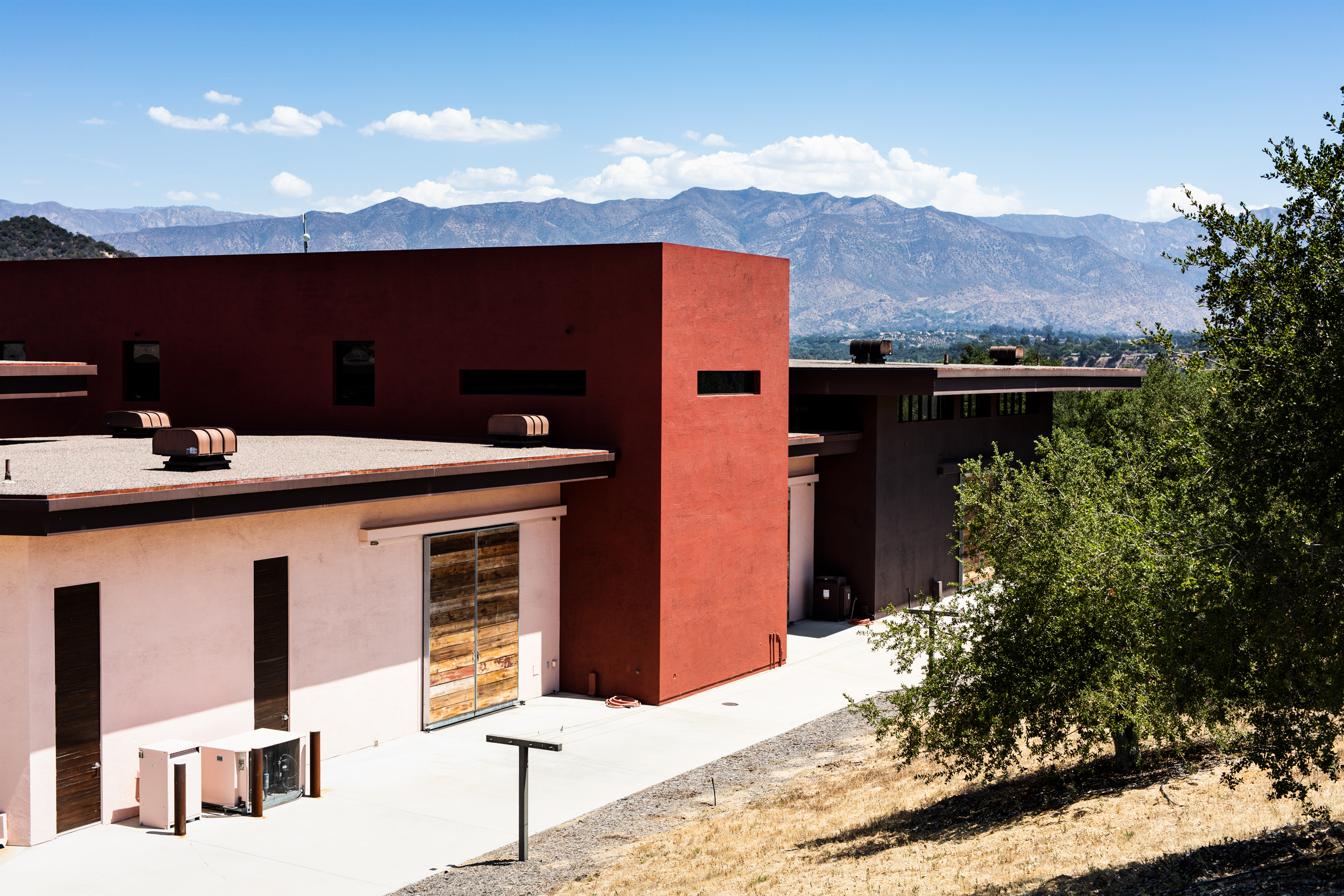
In the early days of Sine Qua Non, from 1994 until 2003, Manfred and Elaine Krankl exclusively purchased fruit from various vineyard sources around California's Central Coast, including Alban, Stolpman, White Hawk, Shadow Canyon, and Bien Nacido. They had very close relationships with each of these growers. John Alban was a mentor to Manfred in his early days of winemaking. Then in 2000/2001, the Krankls purchased and planted the first of their estate-owned vineyards in Sta. Rita Hills: Eleven Confessions. Today, Eleven Confessions has 33 acres planted. The first single vineyard wine made from Eleven Confessions was the 2003 The Inaugural Syrah.
"John Alban helped us plant Eleven Confessions in 2000 and 2001," Manfred told me. "All the Grenache is Alban Clone. The first fruit was harvested in 2003, though there wasn't much of it. From the beginning, the Eleven Confessions wines tended to evolve more slowly, so I keep them in barrel longer."
From 2003, Sine Qua Non began using less purchased fruit and more estate fruit. Today, they own four vineyards in distinctive, disparate sites around California's Central Coast. Cumulus Vineyard is their home vineyard in Oak View (south of Santa Barbara and near Ojai), first planted in 2004, and the winery there was finished in 2012. Cumulus Vineyard is also the exclusive source of one of the Krankls' other labels, Next of Kyn. Molly Aida is a tiny 1.5-acre vineyard located at around 1,800 feet of elevation in Tepusquet Canyon. This fruit is used as a blending component in Sine Qua Non. The Third Twin Vineyard in Los Alamos was purchased by the Krankls in 2010. Like Cumulus and Eleven Confessions, it is also the source of a single vineyard wine/label.
Apart from the change of vineyard sources from 2000 until now and a new state-of-the-art winery facility coming online in 2012 (Eleven Confessions Vineyard will soon also have its own dedicated winery), Manfred Krankl's winemaking has been in a constant state of considered experimentation and refinement. The early wines were, for example, 100% destemmed, but nowadays, Manfred tends to work a lot with whole clusters. Co-fermentations are more common now, especially with a small amount of white grapes. In the early days, a little American oak was used in some of the aging; now, it is all French oak and mainly larger format demi-muids. But more important than understanding the winemaking, is understanding how Manfred blends.
"When I make the wines, I taste all along the way, and the blend develops that way," Manfred explained.
This hasn't changed over the years and remains the foundation of Sine Qua Non's annual releases of individual creations, each composition being based around Syrah or Grenache.

The style of young Sine Qua Non can be polarizing—concentrated, rich, powerfully perfumed wines that are almost always over 15% alcohol and often over 16%. Yet they are also wines of brightness and purity with relatively low pHs for their varieties and ripeness (3.5-3.8), instilling impressive tension and jaw-droppingly plush textures.
I've noted in the past from tasting many Sine Qua Nons in various stages of evolution that the wines tend to age very slowly. It can take 6-10 years for tertiary notes to begin to emerge. This said they do reveal dramatic development and tertiary complexity after about 12 years.
My first impression when studying how the style of Sine Qua Non develops based on the twelve wines I tasted is that the wines become much more classic with significant time in bottle (12 years+). The perfume and flavors branch out into savory, floral, and earthy accents, not unlike a great Côte Rotie or Hermitage. The power on the palate is tamed into a mature fruit grace with whispery undertones in the mid-palate and on the finish. Mature Sine Qua Non is a style I think many would find less polarizing than when it's young, becoming as cerebral as it is harmoniously delicious.
One thing that stood out throughout this tasting was the quality, evocative nature, and age-ability of the wines from the Eleven Confessions Vineyard. Bravo to the Krankls for developing and lovingly maintaining what needs to be recognized as one of the greatest vineyards in California. This is not to slight the wines being made from the other vineyards owned by the Krankls. Cumulus Vineyard has come online more recently, producing mind-blowing single vineyard wines under the Next of Kyn label. But wines like the 2003 The Inaugeral Syrah, 2005 The 17th Nail In My Cranium, 2007 Labels Syrah, and 2008 The Duel Grenache—all exclusively or mainly from Eleven Confessions—are shaping up to be legendary, and still have a long way to go.
As for the current and upcoming 2021 and 2022 releases from Sine Qua Non, Next of Kyn, and The Third Twin, Manfred commented, "2021 for us was a cooler, even vintage. The grapes just cruised along. I think that's where that brightness comes from in these wines. In 2022, we had a heat spell, but nothing too dramatic. Except our yields were down by about a third."
Indeed, the 2021s are like shimmery beacons, yet 2022s don't miss a beat, mainly due to the dry-climate, heat-loving nature of the Rhône varieties and other varieties such as Touriga Nacional and Graciano that the Krankls have planted.
Finally, circling back to the question posed in my introduction: Is it worth cellaring these densely layered, hedonic creations, or is it better to drink them on the young side?
Yes.
–
Article & Reviews by Lisa Perrotti-Brown MW
Photography by Svante Örnberg
See more work from Svante at svanteornberg.se by clicking here!

PRODUCERS IN THIS ARTICLE
> Show all wines sorted by scoreMore articles
Château Le Dôme 1997-2022
10th Sep 2026
9 tasting notes
Bordeaux 2024 Revisited
03rd Sep 2026
69 tasting notes
Château Jean Faure 2004-2023
10th Jul 2026
10 tasting notes
Bordeaux 2025 En Primeur
07th May 2026
382 tasting notes
Show all articles