11th Nov 2025
Bordeaux, as a region, is as complex and multifaceted as the wines it produces.
Firstly, it has two banks, and secondly, about 65 appellations (a number that continues to grow - Médoc Blanc AOC was only recently introduced, and Saint-Émilion Blanc will likely follow soon). When we say “Bordeaux,” we run the risk of oversimplifying a place defined by its diversity.
Vintage Paradox
Among Bordeaux’s many contradictions, few are as striking as the vintage paradox - years celebrated as monumental for the region as a whole may have told very different stories in its individual appellations. One of the clearest examples lies in Pessac-Léognan, through the comparison of 1982 and 1983.
1982 — The Warm Embrace
1982 is remembered as one of the greatest vintages in Bordeaux’s history - a year of perfect weather, generous yields, and opulent, concentrated wines of extraordinary longevity. Yet to claim it was universally great is an oversimplification.
While the Médoc’s gravel soils and Cabernet Sauvignon thrived under the warm, sunny conditions, Graves — and by extension, Pessac-Léognan faced a different reality. The region’s gravels, which heat faster than clay or limestone, became almost too warm. By harvest, acidity levels had dropped and freshness was lost, particularly in the lower-lying parcels around Léognan and Martillac.
The wines were never poor - in fact, they were soft, velvety, with a certain sweet charm that made them instantly appealing. But compared with their Médoc or Right Bank counterparts, their aging potential was limited.
Thus, 1982 in Pessac-Léognan was already approachable a few years after bottling - something that could hardly be said about 1983.
1983 — The Forgotten Balance
In Bordeaux as a whole, 1983 is often seen as an “average” vintage. But in Pessac-Léognan, it was a quietly beautiful one.
After a wet winter and a cool spring that delayed flowering by nearly two weeks, the summer brought alternating spells of warmth, storms, and rain. Yet this unpredictability preserved acidity and thickened the skins: a key to the vintage’s freshness and structure. In the lower sites, some grey rot appeared in late August, but the gravelly soils around Pessac, with their drainage and air flow, prevented real damage.
Then came perfection — from early September to mid-October, the weather turned long, dry, and luminous. It was “August in autumn”: warm enough for ripeness, cool enough to retain purity and minerality.
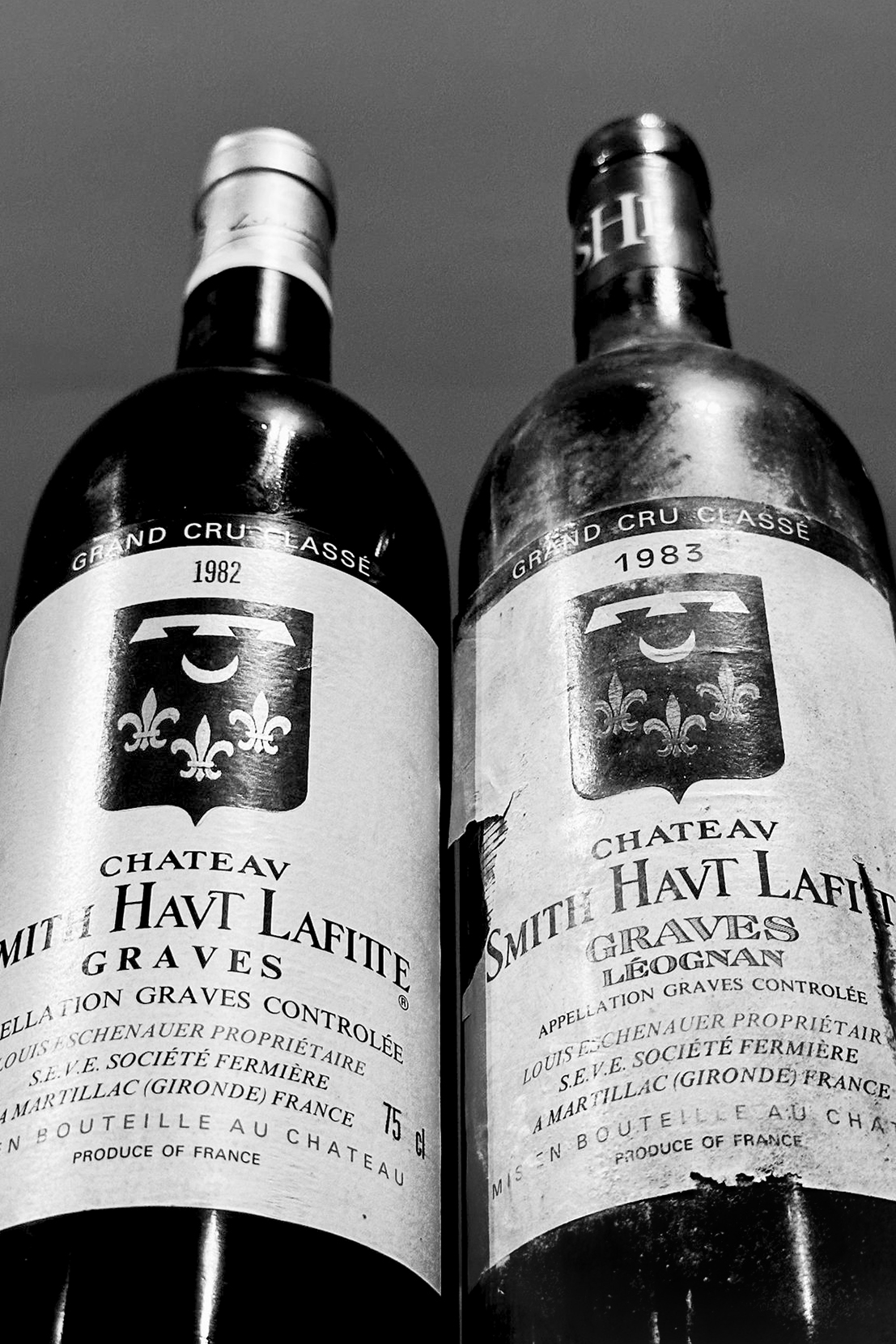
A Tale of Two Smith Haut Lafitte
Before the Cathiard family acquired Château Smith Haut Lafitte in 1990, the estate was owned by Bernard and Françoise Ducasse. To be fair, during their tenure the vineyards were maintained, but without vision.
Florence Cathiard once said: “When we arrived, Smith Haut Lafitte had lost its shine. The terroir was magnificent, but it was asleep.”
And indeed, only that magnificent, though sleeping, terroir carried those wines through the decades.
The 1982 still retains the gentle sweetness that defined Pessac-Léognan that year. The bouquet, dominated by tertiary notes, hides a faint trace of red fruit - elegant yet fading. The tannins are soft, the finish medium, the impression graceful but lacking the true soul of Pessac-Léognan’s gravel. After an hour in the glass, the brightness begins to fade, and the wine slowly withdraws into silence.
The 1983, however, tells a different story.
The nose is more expressive - vivid red fruits intertwined with charred wood, tobacco, leather, and black tea. The palate is firmer, better structured, the tannins integrated, the acidity alive. Here, one can feel the signature of the terroir more distinctly, that refined tension and mineral depth that only gravel can provide.
When the Cathiards purchased the château, several older vintages still rested in the cellar. They tasted them with Michel Rolland, and Florence recalled:
“1982 and 1983 were soft - not harsh, but also not sculpted. Michel told us, ‘The terroir is great, but the wine doesn’t say it yet.’”
Even now, more than forty years later, these wines whisper rather than sing, yet they are still alive, carried by that very greatness of terroir Michel recognized.
Awakening the Sleeping Beauty
It was deeply moving to taste these fragments of history - the wines that quietly bridge the gap between what Smith Haut Lafitte was and what it has become.
Over the past 35 years, Florence and Daniel Cathiard have revived this sleeping beauty and transformed it into one of Bordeaux’s most complete and expressive estates.
And I can’t help but imagine that, in 2060, I’ll open the 2015 and 2016 side by side - to draw a new parallel with these two vintages from the past.
Florence once said:
“These old vintages remind us where we came from. They are not great wines - but they are the ones that awakened our desire to bring this place back to the greatness it deserves.”

PRODUCERS IN THIS ARTICLE
> Show all wines sorted by scoreMore articles
Château Le Dôme 1997-2022
10th Sep 2026
9 tasting notes
Bordeaux 2024 Revisited
03rd Sep 2026
69 tasting notes
Château Jean Faure 2004-2023
10th Jul 2026
10 tasting notes
Bordeaux 2025 En Primeur
07th May 2026
382 tasting notes
Show all articles